
26
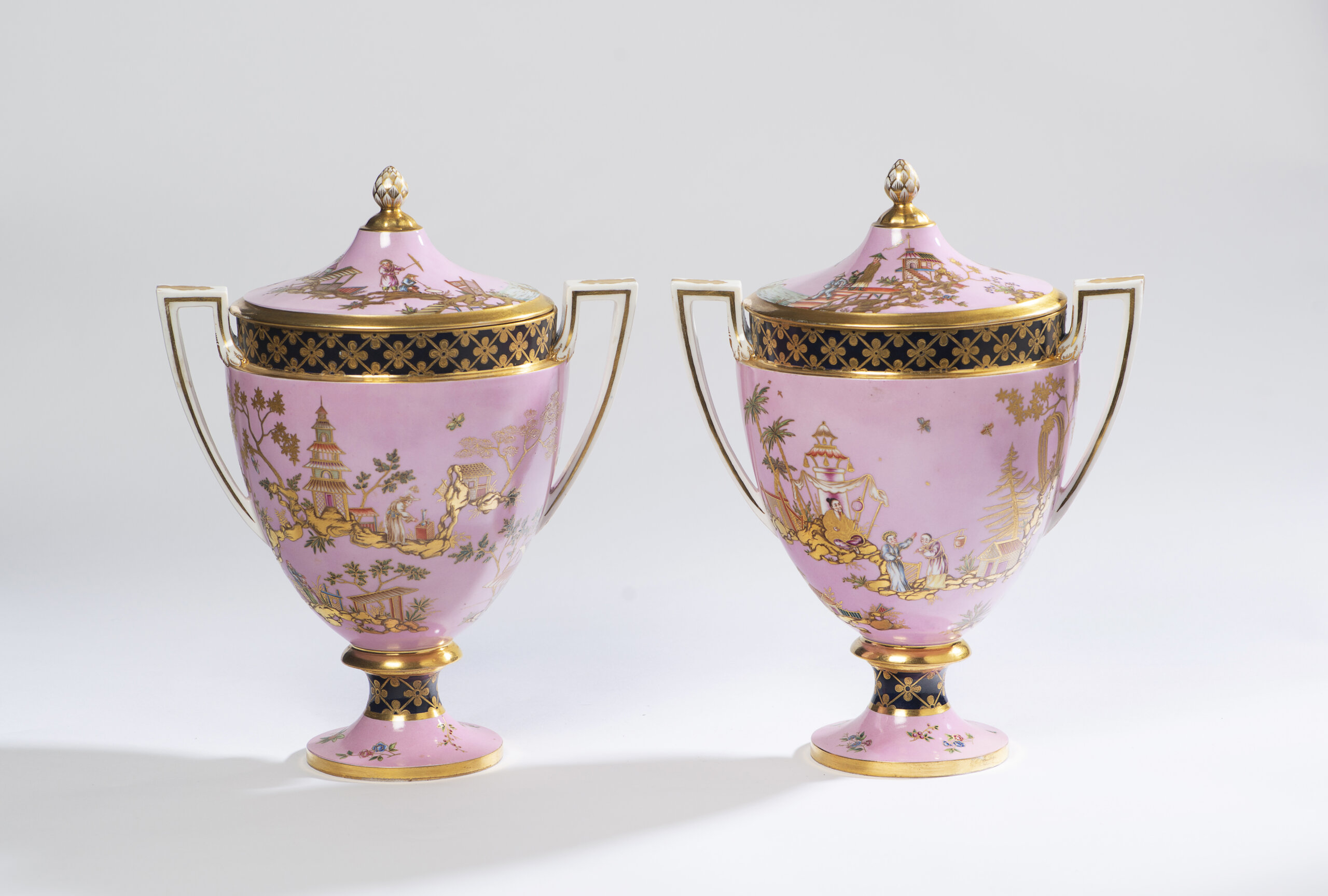
A Rare Pair Of Imperial Vienna Porcelain Covered Urns
Estimate
30.000 - 35.000
Session 1
4 June 2025
Hammer Price
Register to access this information.Description
Imperial and Royal Porcelain Manufactory, Vienna
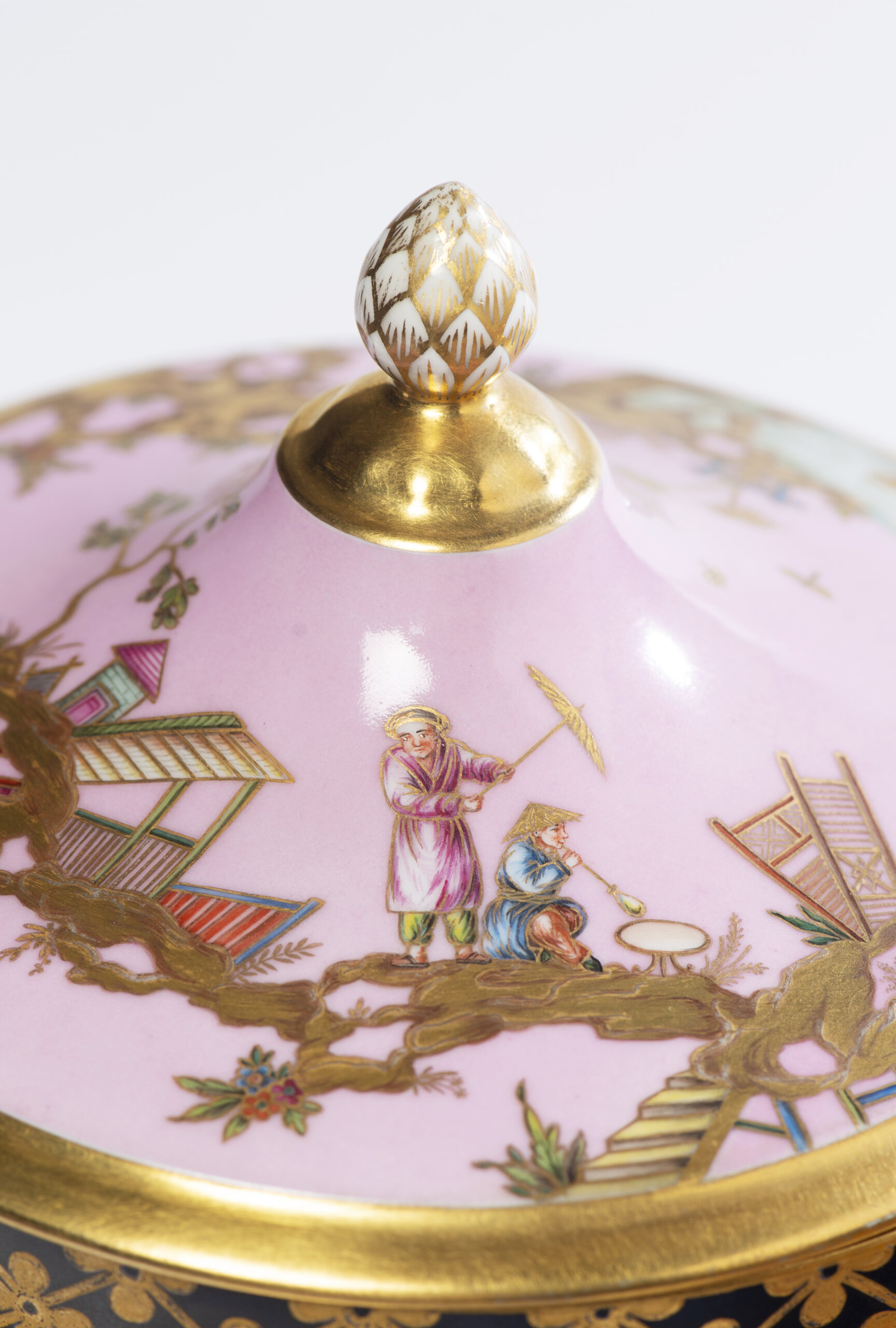
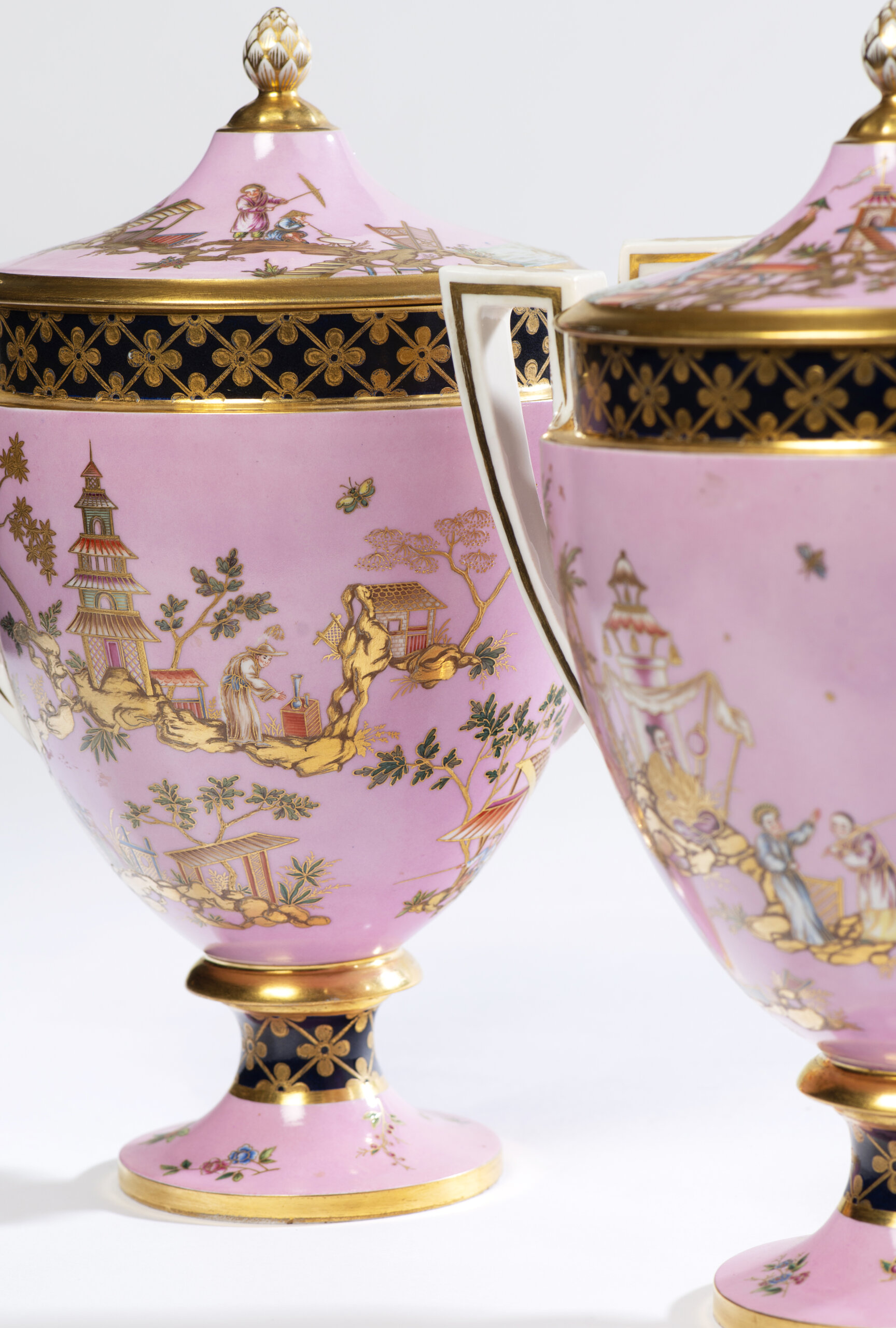
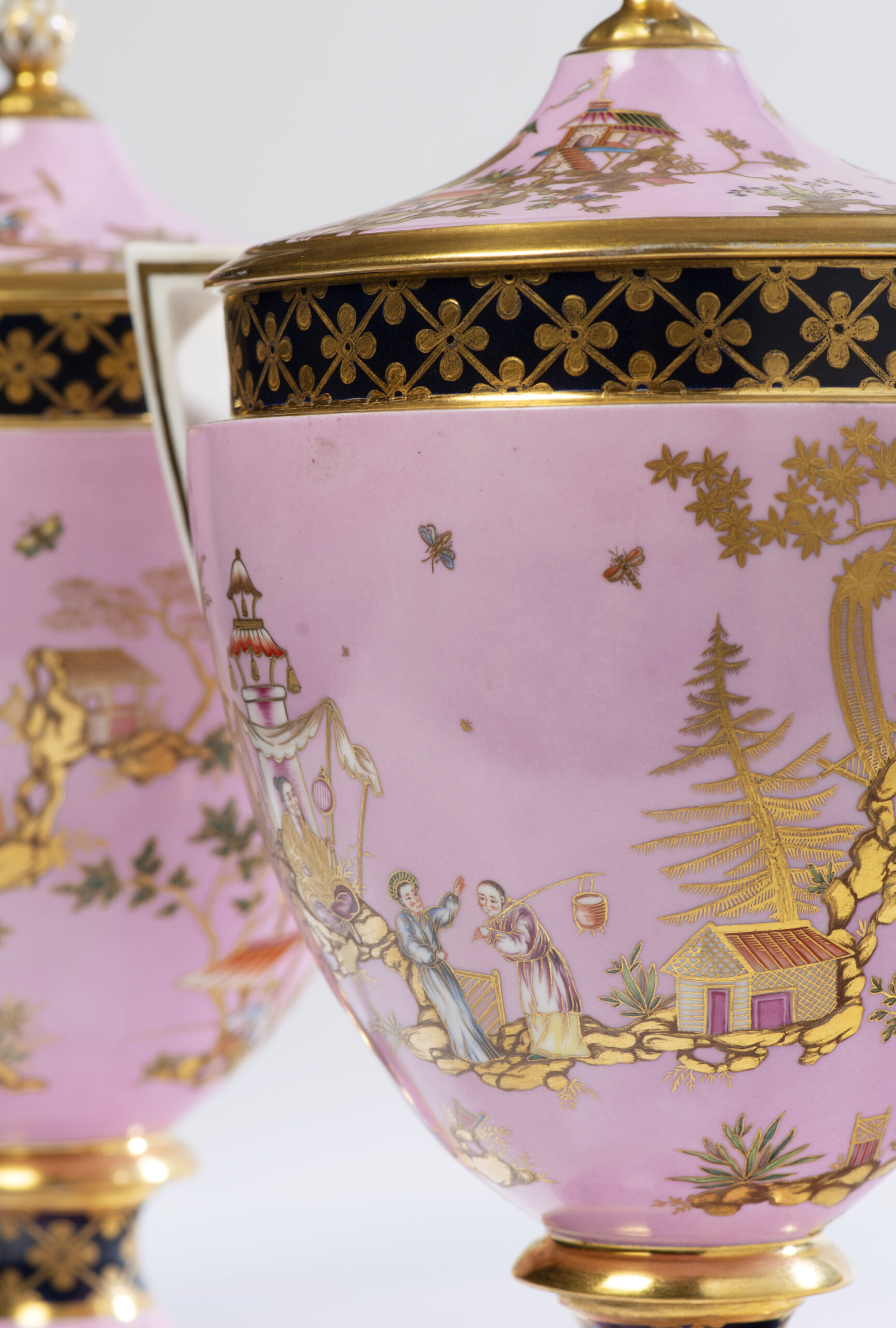
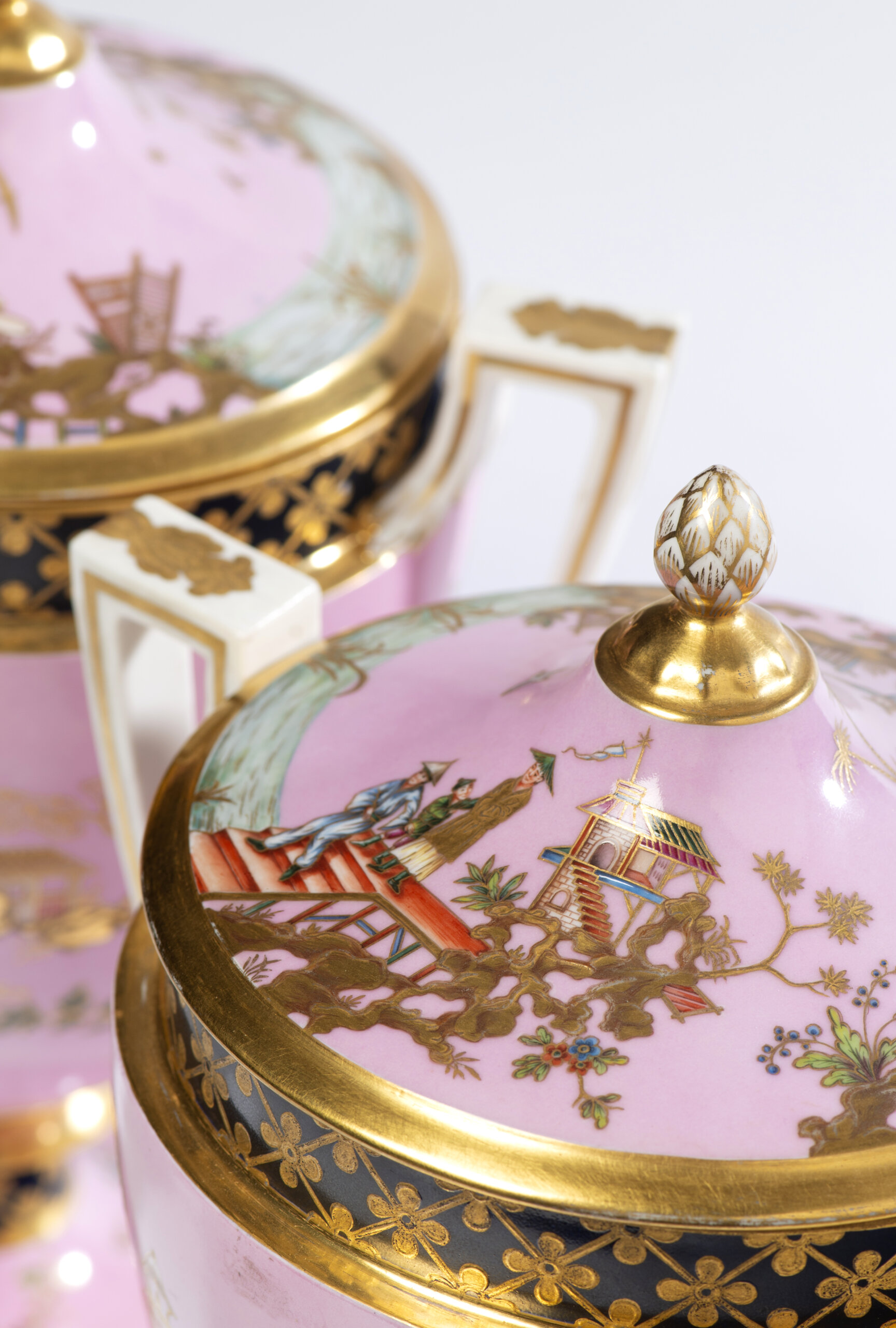
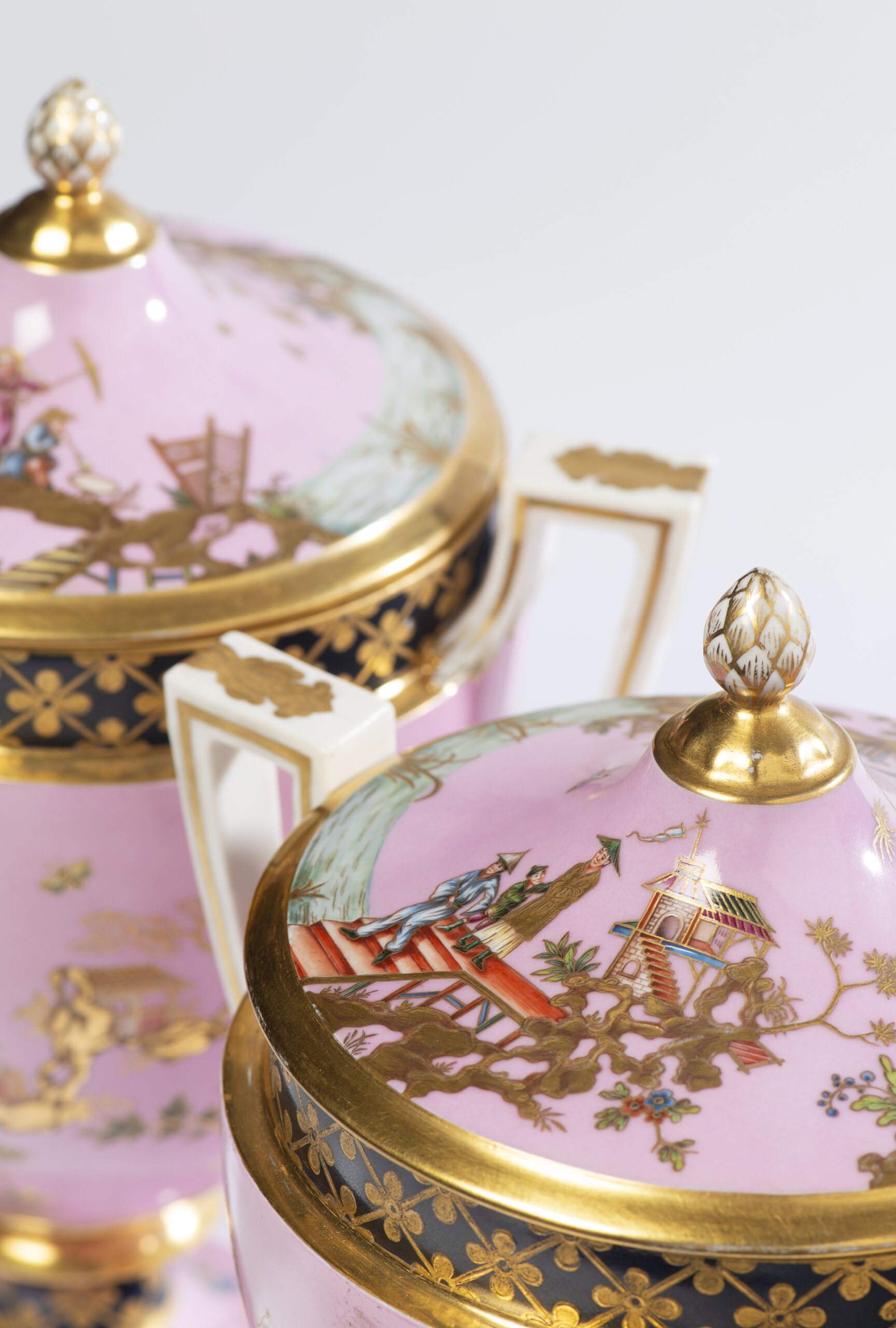
Of classical silhouette, with ovoid bodies and elegant profiles, each surmounted by a gently curved conical lid topped with a pinecone-shaped finial. Both urns flanked by two tall, rectilinear handles rising in harmony with the form of the body.
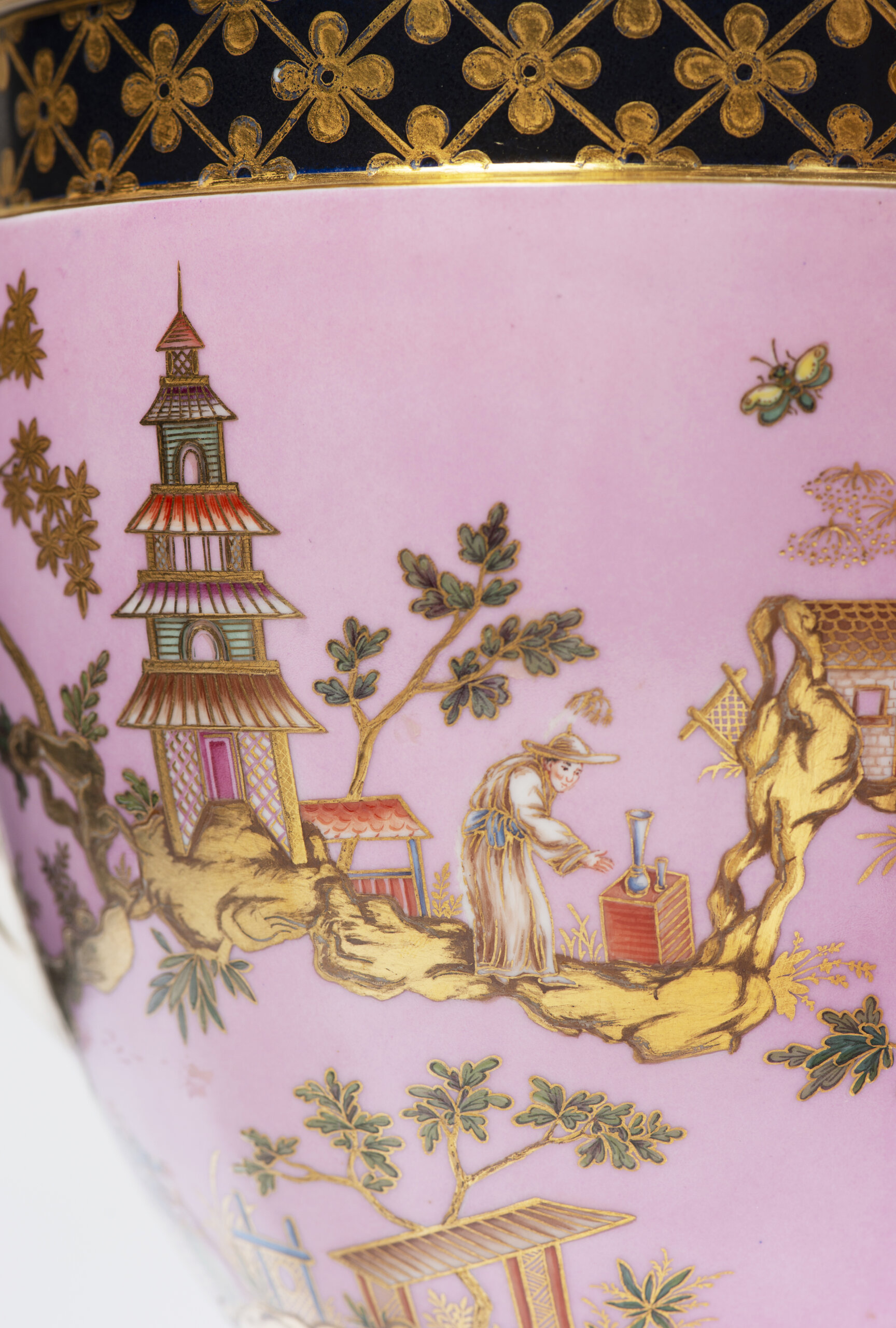
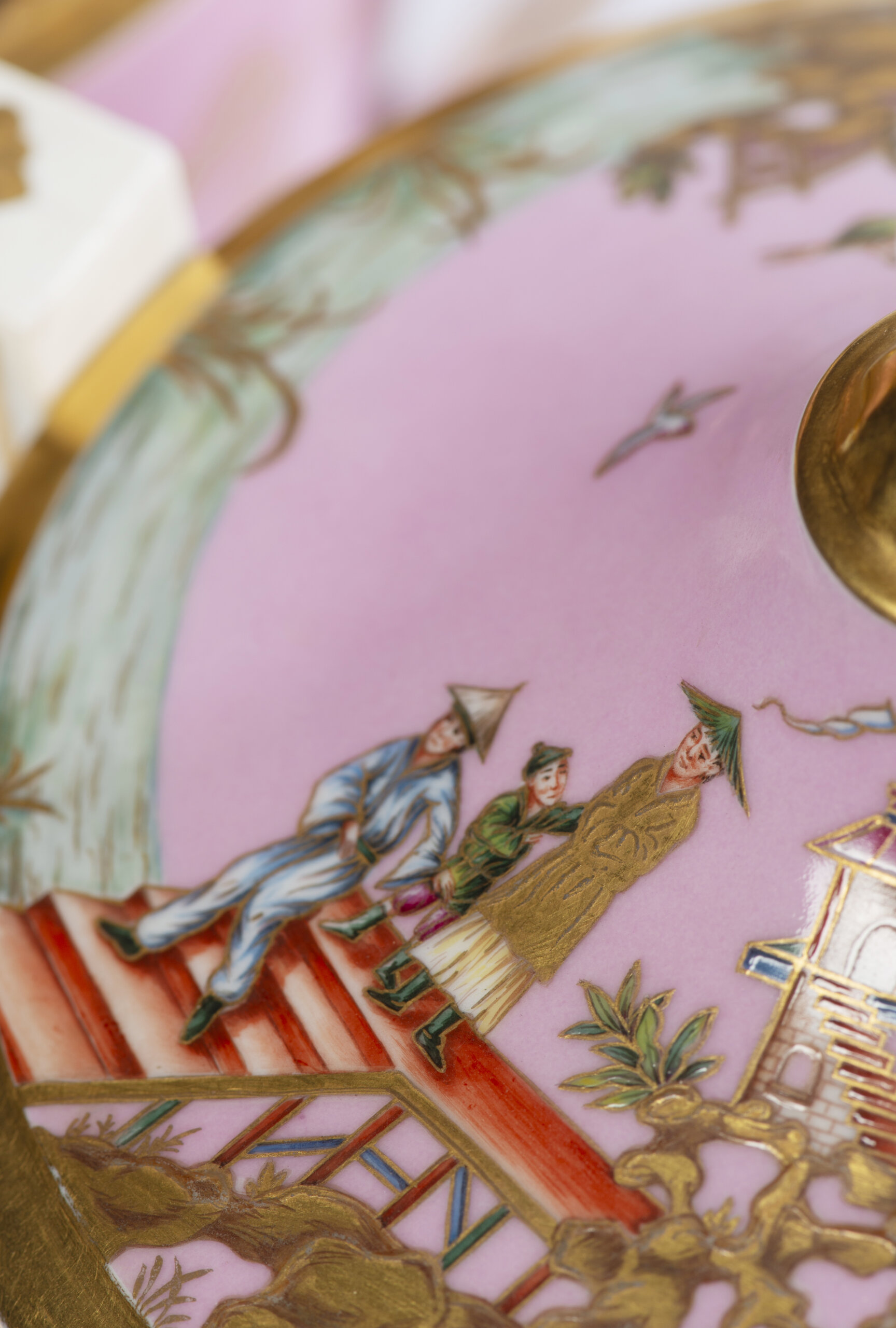
Finely decorated in gold and polychrome enamels on a translucent Pompadour pink ground, with chinoiserie scenes inspired by compositions by Jean-Baptiste Pillement (1728–1808), depicting oriental figures in exotic gardens with pavilions and stylised botanical elements.
The neck and foot are adorned with gilt trellis bands of clover motifs on a black ground.
Marked underglaze in blue with the Imperial Vienna ‘Bindenschild’; red-painted decorator’s number ‘62’, attributable to Franz Gärtner (active 1771–1841); and impressed numbers ‘801’ (year mark for 1801) and ‘12’.
Austria, 1801
(minor restorations)
Height: 29,7 cm
Category
Porcelain
Additional Information
Literature:
Á. S. Guimarães da Mota, Gravuras de chinoiserie de Jean-Baptiste Pillement, vol. 1 – Texto, Faculdade de Letras da Universidade do Porto, Porto, 1997.
E. Sturm-Bednarczyk e C. Jobst, Viennese Porcelain of Classicism: The Era of Conrad von Sorgenthal 1784–1805, Christian Brandstätter, Viena, 2000.
V. Finlay, Rose: Madame Pompadour’s Luxurious Pink, in The Brilliant History of Color in Art, J. Paul Getty Museum, Los Angeles, 2014.
La Porcelaine de Sèvres du XVIIIe siècle. Catalogue de la collection, Hermitage Museum, São Petersburgo, 2005.
W. Neuwirth, Wiener Porzellan 1718–1864, Viena, 1979, pp. 48, 366.
MAK Collection Online: Works of the Vienna Porcelain Manufactory Augarten.
A Pair of Covered Urns from the Imperial Vienna Porcelain Manufactory: Exoticism and Refinement
This rare pair of covered urns from the Kaiserlich-Königliche Porzellan-Manufaktur Wien exemplifies the technical and artistic excellence achieved during the directorship of Konrad von Sorgenthal (1784–1805), a pivotal figure in the history of the Viennese manufactory. Under his leadership, the factory gained international acclaim, competing with the most prestigious European porcelain centres through a successful balance of artistic refinement and commercial acumen.
Dated 1801, these pieces are adorned with an exceptional chinoiserie decoration over a Pompadour pink ground, executed by the painter Franz Gärtner, whose identifying number “62” is painted in red on the base of each urn. Active from 1771 until 1841, Gärtner was one of the manufactory’s most accomplished artists, widely recognised for the precision and delicacy of his painted ornament.
The scenes on these urns closely echo compositions by Jean-Baptiste Pillement (1728–1808), the French artist whose chinoiserie designs became highly influential throughout Europe between the 1750s and 1770s. Pillement’s visual vocabulary combined stylised Oriental figures, pavilions, fantastical vegetation and decorative fantasy, establishing a picturesque idiom that was broadly imitated in porcelain, textiles and mural painting.
The vibrant Pompadour pink that frames these scenes has a story of its own. Originally developed at the Manufacture Royale de Sèvres, the colour was named in honour of Madame de Pompadour, Louis XV’s influential mistress and a great patron of the arts. This luminous and unmistakable shade – arguably the first example of a personal brand colour in decorative arts history – was referred to in France simply as rose, but across Europe it was already known by association with its celebrated sponsor. According to legend, Madame de Pompadour declared, upon turning thirty, that her “days of wearing pink were over” – yet the colour endured in porcelain decoration as a lasting symbol of elegance and refinement.
Although the neoclassical, à l’antique form of these urns was widely used by the Vienna manufactory during Sorgenthal’s tenure, the specific combination of form, palette and chinoiserie decoration seen here is exceedingly rare. Striking parallels may be drawn with the “vase œuf à monter” model from the Manufacture Royale de Sèvres – particularly with one example preserved in the Hermitage Museum in Saint Petersburg, and two others held in private collections, all dated 1779–1780. The resemblance lies not only in the ovoid form and painted subjects, but also in the way Franz Gärtner emulated, through finely painted gilt ornament on a black ground, the ormolu mounts that adorn the French prototypes. This remarkable trompe-l’oeil treatment suggests that these urns may have been produced as a special commission, likely for a client familiar with the original Sèvres works.
Beyond their formal beauty and technical finesse, these urns stand as testament to the rich artistic dialogue between Europe’s major porcelain centres. They embody a moment in which the circulation of images, techniques and ideas gave rise to some of the most brilliant achievements in the history of European decorative arts.
João Francisco Barreto
Closed Auction
