
25
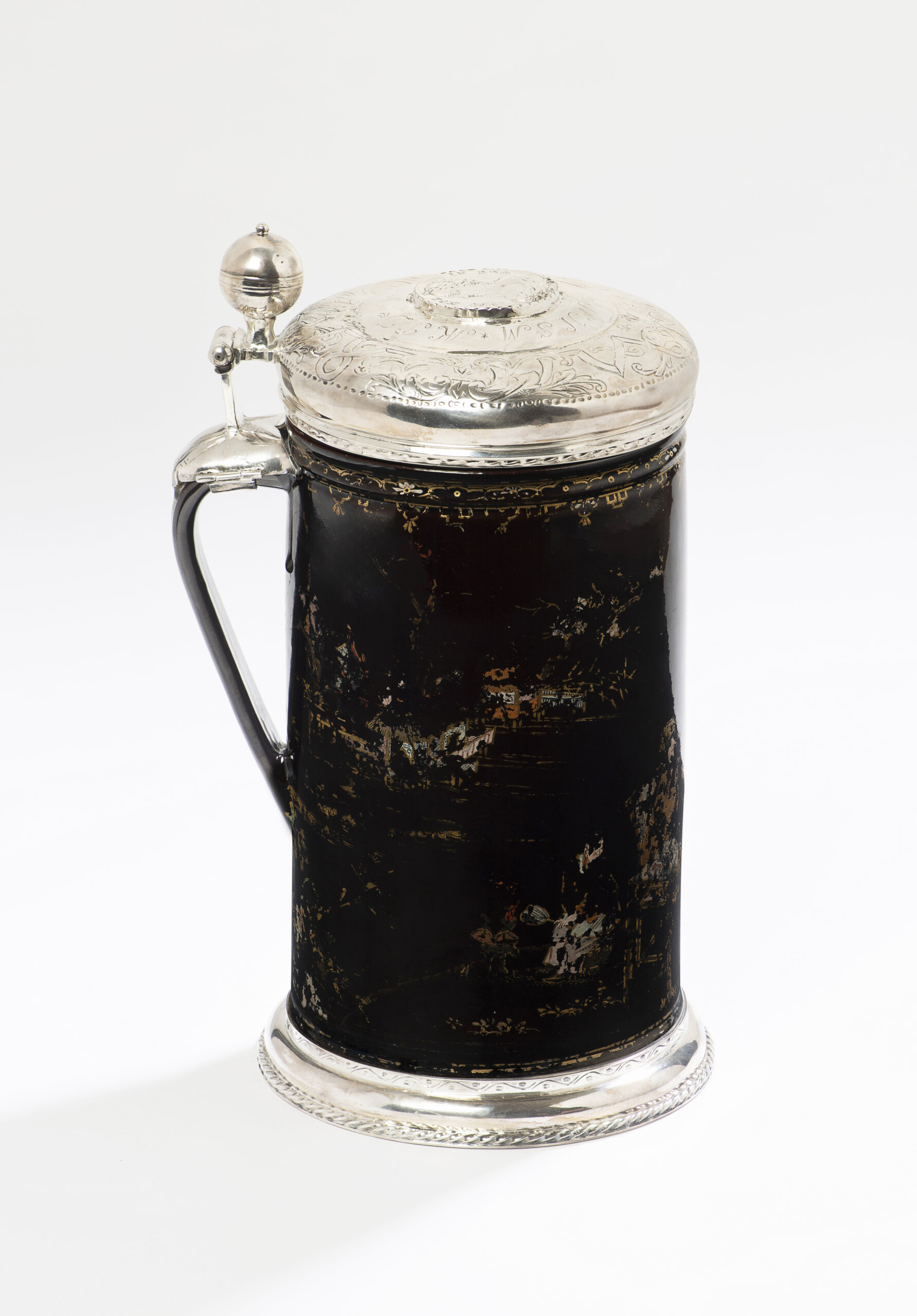
An extremely rare Meissen Böttger stoneware tankard with silver mounts
Estimate
22.000 - 26.000
Session 1
4 June 2025
Hammer Price
Register to access this information.Description
Böttger stoneware with black glaze, cold-painted and gilt decoration, and silver mounts
Of cylindrical form with a strap handle, moulded in Böttger red stoneware and covered with a lustrous black glaze. The decoration, applied cold using coloured lacquers and gold, is attributable to the workshop of Martin Schnell and features motifs of Oriental inspiration. Although visibly worn, traces of figures, architectural elements, and floral motifs remain, recalling the chinoiserie compositions characteristic of works painted by Schnell and his workshop for the Dresden court.
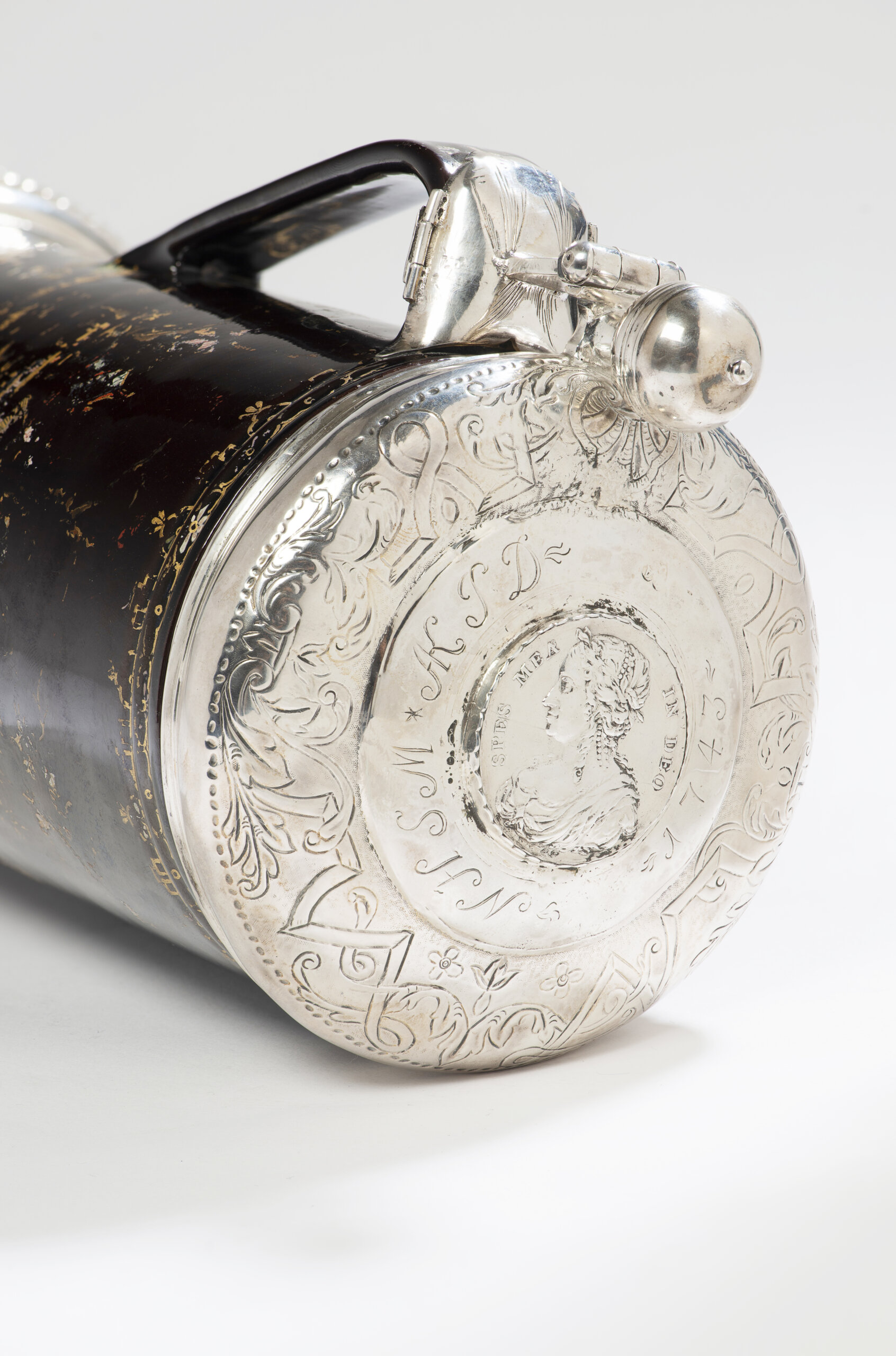
The hinged cover and foot mount are made of moulded silver, finely engraved. At the centre of the cover is an inserted medal bearing the portrait of Queen Sophie Amalie of Denmark and Norway, surrounded by the Latin motto SPES MEA IN DEO (“My hope is in God”). Around the medal are engraved the initials NHSM ✶ AKPD and the date 1743. The remaining surface of the cover is ornamented with foliate scrolls and other phytomorphic motifs, and above the hinge sits a spherical thumbpiece segmented with raised horizontal ribs.
Inscribed in black on the underside with the number "25"
Germany, Meissen, c. 1710–1715.
Commemorative medal, bearing the portrait of Queen Sophie Amalie of Denmark and Norway datable to around 1650.
Silver mounts, probably Denmark, dated 1743, bearing a partially illegible, unidentified maker’s mark.
Height: 24,5 cm
Category
Silver
Böttger: Art, Alchemy and Exoticism at the Court of Augustus II
Produced between 1710 and 1715 at the newly founded Meissen manufactory, this exceptionally rare tankard in black-glazed red stoneware (Böttger Steinzeug) belongs to a very limited group of objects decorated in cold-painted chinoiserie and later mounted in silver. The material, developed by Johann Friedrich Böttger before the invention of European porcelain, was prized for its density, lustre, and its ability to be polished to a finish comparable to semi-precious stone. A rich black glaze was applied, serving as the ground for decorative interventions by artists such as Martin Schnell, who adorned these surfaces with gold and coloured lacquers, emulating the appearance of Asian lacquerware.
Johann Friedrich Böttger (1682–1719), originally an alchemist in the service of Augustus II of Poland, was charged with discovering the philosopher’s stone. Instead, he succeeded in creating Europe’s first high-fired stoneware, and subsequently its first hard-paste porcelain. The red Böttger stoneware, developed around 1707–1708, quickly became one of the most prestigious ceramic materials in Europe, even before the porcelain formula was finalised in 1710. The earliest black-glazed pieces were often experimental in nature, combining cutting-edge ceramic technology with luxury decoration techniques, and were typically reserved for presentation or courtly use. Their aesthetic was closely aligned with the taste for the exotic that prevailed at the Saxon court, strongly influenced by imported Chinese and Japanese lacquer and porcelain.
The decoration on this piece, applied cold using gold and coloured lacquers over the glazed surface, imitates the visual effect of true lacquer while adapting its iconography to the European imagination. The extreme fragility of this technique explains why so few examples survive with their decoration intact. Even in objects where the painting has significantly worn away, as in the present example, the historical, artistic, and technical value remains unquestionable.
The attribution of this decorative work to the workshop of Martin Schnell is now widely accepted. Schnell was appointed Hoflackierer (Court Lacquerer) by Augustus II in 1710, and was active not only in the decoration of furniture and interior elements but also of stoneware and early porcelain. His workshop stands among the most sophisticated manifestations of chinoiserie in early 18th-century Europe. A tankard now in the Museum of Applied Arts in Budapest (inv. 5861), decorated with cold painting and attributed to Schnell, offers a close comparison. Another tankard in the collection of the Museum of Fine Arts, Boston, displays a gilded border strikingly similar to the present piece.
The market value of such rare examples reflects their art-historical importance. In 2021, a closely related tankard - decorated with cold-painted and gilt chinoiserie scenes and mounted in silver-gilt - was sold by Sotheby’s New York for 252,000 USD (Sammlung Oppenheimer | Important Meissen Porcelain, 14 September 2021, lot 4).
João Francisco Barreto
Closed Auction
