
99
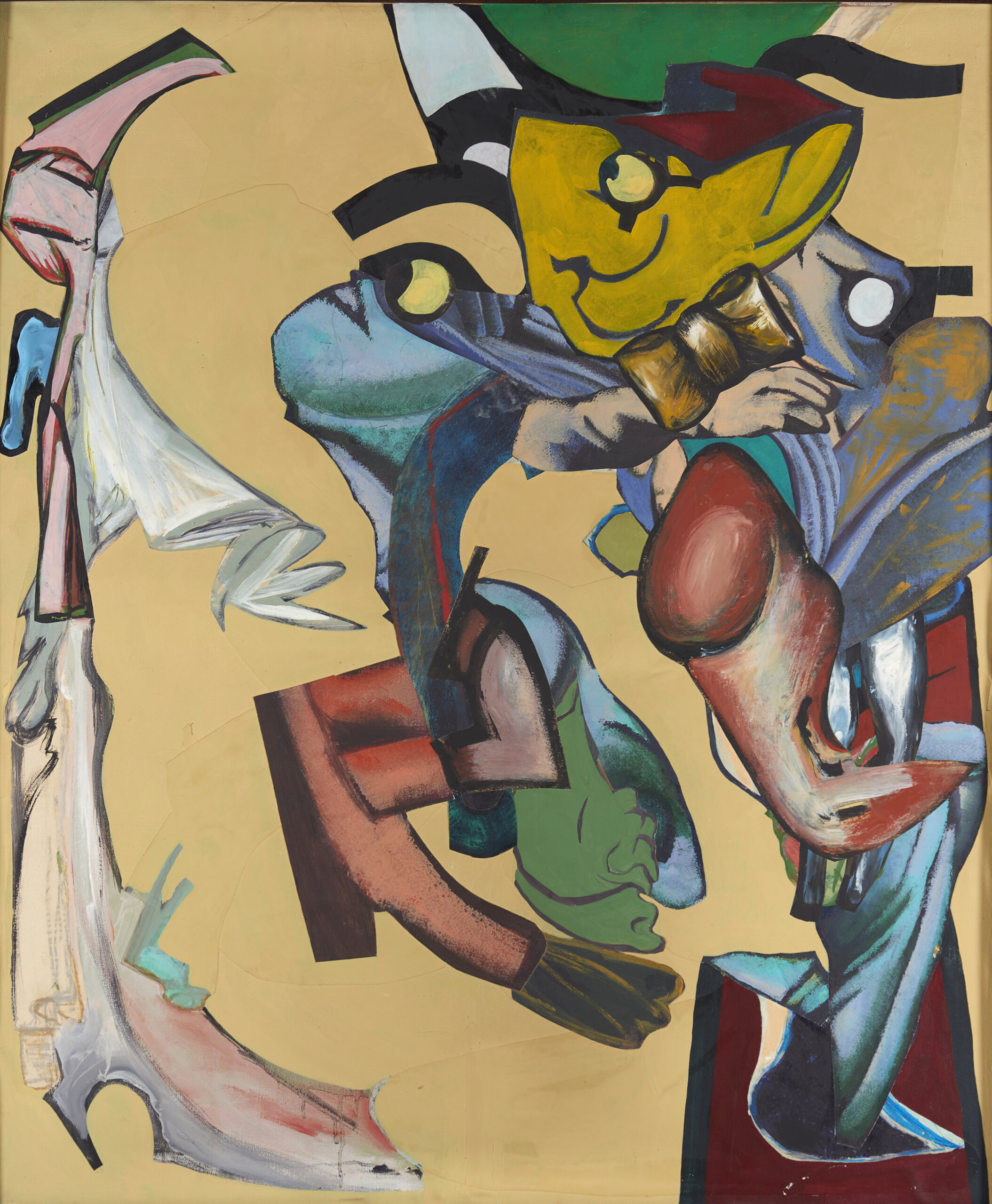
"O Anão Amarelo"
Paula Rego (1935-2022)
Estimate
150.000 - 180.000
Session
31 March 2025
Hammer Price
Register to access this information.Description
Acrylic, gouache and paper laid on canvas
Signed and dated 78 on the reverse
106,5x88,5 cm
Category
Modern and Contemporary Art
Additional Information
Provenance:
Galeria 111, Lisboa;
Private collection.
Exhibitions:
Paula Rego, Galeria 111, Lisboa, Galeria Zen, Porto, 1978, Cat. Rep. p/b nº 8; "Histórias de todos os dias. Paula Rego, anos 70", Casa das Histórias Paula Rego, Cascais, 2023.
Catalogue Essay
Universal Stories and Emotions
Catarina Alfaro
Coordinator of Programming and Conservation of Paula Rego House of Stories/D. Luís I Foundation
In 1976, Paula Rego set out to "illustrate more prolifically the traditional Portuguese tales or integrate these timeless tales into our contemporary mythology and personal experience through painting," as she writes in her application for a fellowship from the Calouste Gulbenkian Foundation. Once the fellowship was granted to her, she began researching fairy tales and the respective illustrations of authors from different nationalities and periods in the libraries of the British Museum and the Victoria & Albert Museum, as well as in the national libraries of France and Portugal.
In her extensive research conducted between 1976 and 1978 on "classic fairy tales," Paula Rego highlights the French writer Marie-Catherine d’Aulnoy (1650–1705). Better known as Madame d’Aulnoy, Rego considers her "the greatest storyteller of her time," and she is the author of the tale that directly served as a reference for the creation of this work, ‘Le Nain jaune’ / ‘The Yellow Dwarf’. This tale, which is part of the book ‘Contes de Fées’ published in Paris at the end of the 17th century, may have been consulted by the artist at the Nationale Library of France.
Establishing as a working plan a systematic approach to fairy tales and folk tales from around the world through close contact with the stories from their universal origins, the "collective unconscious" – a concept developed by Carl Gustav Jung – the artist created, between 1977 and 1978, several works that give a contemporary form to traditional fairy tales, using a method of free and automatic composition. This work is part of a set of pieces that visually materialize the intention expressed in her fellowship application, both in terms of the theme addressed and its formal approach.
In this painting, three characters from the tale ‘The Yellow Dwarf’ are identifiable. The villain of the story, distinguishable by his yellow face, is depicted on the right side of the canvas, rising from the trunk of a tree where he lived, as described in Madame d'Aulnoy’s story. The dismembered female figure in the center represents the queen, who leaves her kingdom in search of the wise counsel of the Fairy of the Desert – who appears on the left side of the work – to marry her daughter, Toute-Belle, to the best suitor. During this journey to the desert, the queen is attacked by a group of lions. Only with the help of the Yellow Dwarf can the queen escape, but in exchange for her salvation, he demands "the hand" of her daughter.
It is in an unreal setting, without time or space, typical of fairy tales, that Paula Rego represents in detail and literally the cruelty of this literary genre by placing the princess's cut-off hand, wrapped in a ribbon, next to the Yellow Dwarf, who simultaneously holds the queen by her veil, making her a hostage of his malice. In the visual interpretation of the tale, Rego continues the formal experimentation she proposed in her Gulbenkian fellowship application. Although still using "painting-collage" – albeit with technical and formal characteristics distinct from the works created in the early 1960s – from a technical perspective, the construction of the work follows the principles established by the artist during the 1970s, particularly the use of acrylic paint instead of oil paint, which provides a faster working process and allows for the exploration of a more diverse and vivid set, reflecting the latest trends in London fashion and pop culture imagery. The large background is filled with yellow, from which figures and other elements drawn with gouache or acrylic paint stand out, with well-defined outlines, cut out and glued, and methodically introduced. As a result, the pictorial surface becomes flat, without shadows or perspective, due to the saturation of color with strong and contrasting tones to define forms and backgrounds. One can also appreciate other dominant formal characteristics in the 1970s compositions, in works where the artist seeks to "update the configuration" of traditional fairy tales. The strangeness of the composition created through the distortion and interweaving of figurative elements, which aggregate and transform through an elastic tension, suggests a sense of vertigo, irrationality, and dreamlike quality. However, this composition – stripped down compared to other works created in 1978 – already points to the compositional structures of works from the 1980s, which present a reduced cast of three characters, positioned as if they were on a stage whose set has no coordinates of space or time.
In the fantasy and supernatural worlds of fairy tales, we find raw and violent stories that, when intersecting with the artist's personal experience, are transferred to painting through her own symbolic language. But, as Paula Rego defends based on her knowledge of Jungian theories, these universal stories contain a symbolism essential for understanding human behavior, and their creative approach through works of art allows their meanings to directly address universal instincts and emotions. Perhaps for this reason, the presence of folk tales remains underlying in her work, materialized in the way an indefinable relationship is established between the real and the unreal.
Closed Auction
