
306
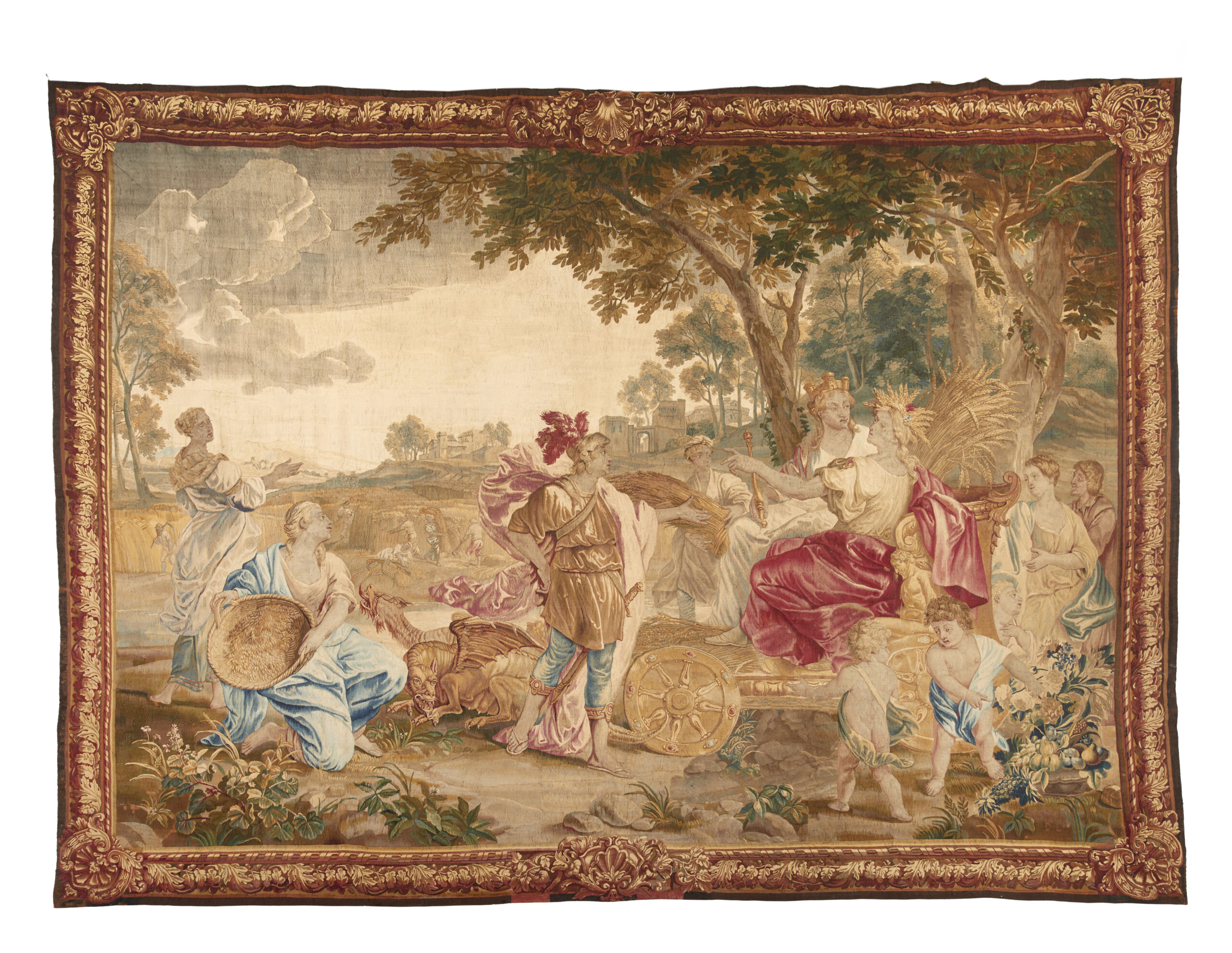
The Triumph of Ceres by Leyniers
Estimate
15.000 - 20.000
Session 2
16 December 2025
Hammer Price
Register to access this information.Description
Brussels manufacture, workshop of Urbanus and Daniel Leyniers
After cartoons by Jan van Orley (1665–1735) and Augustin Coppens (1668–1740)
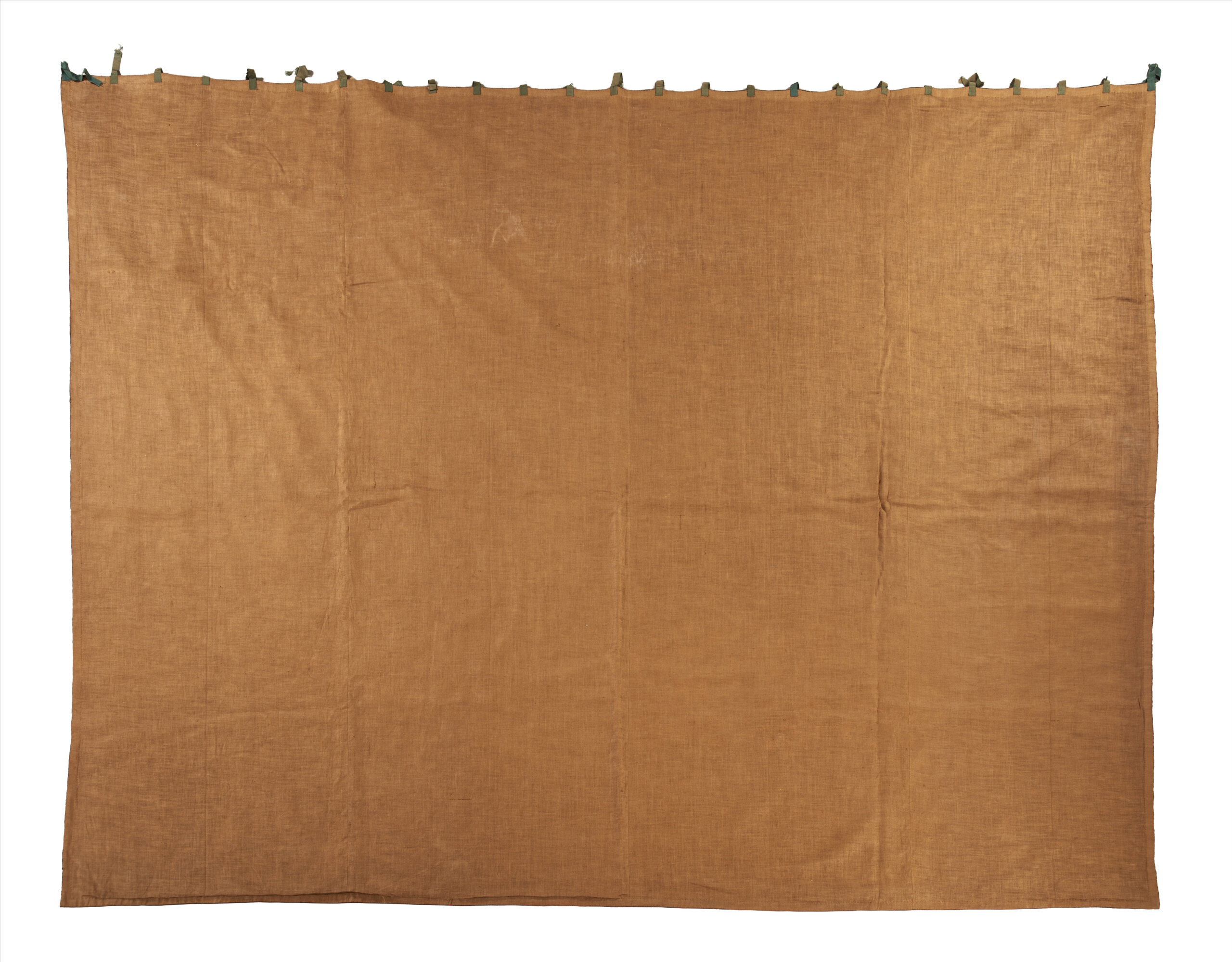
Tapestry in wool and silk
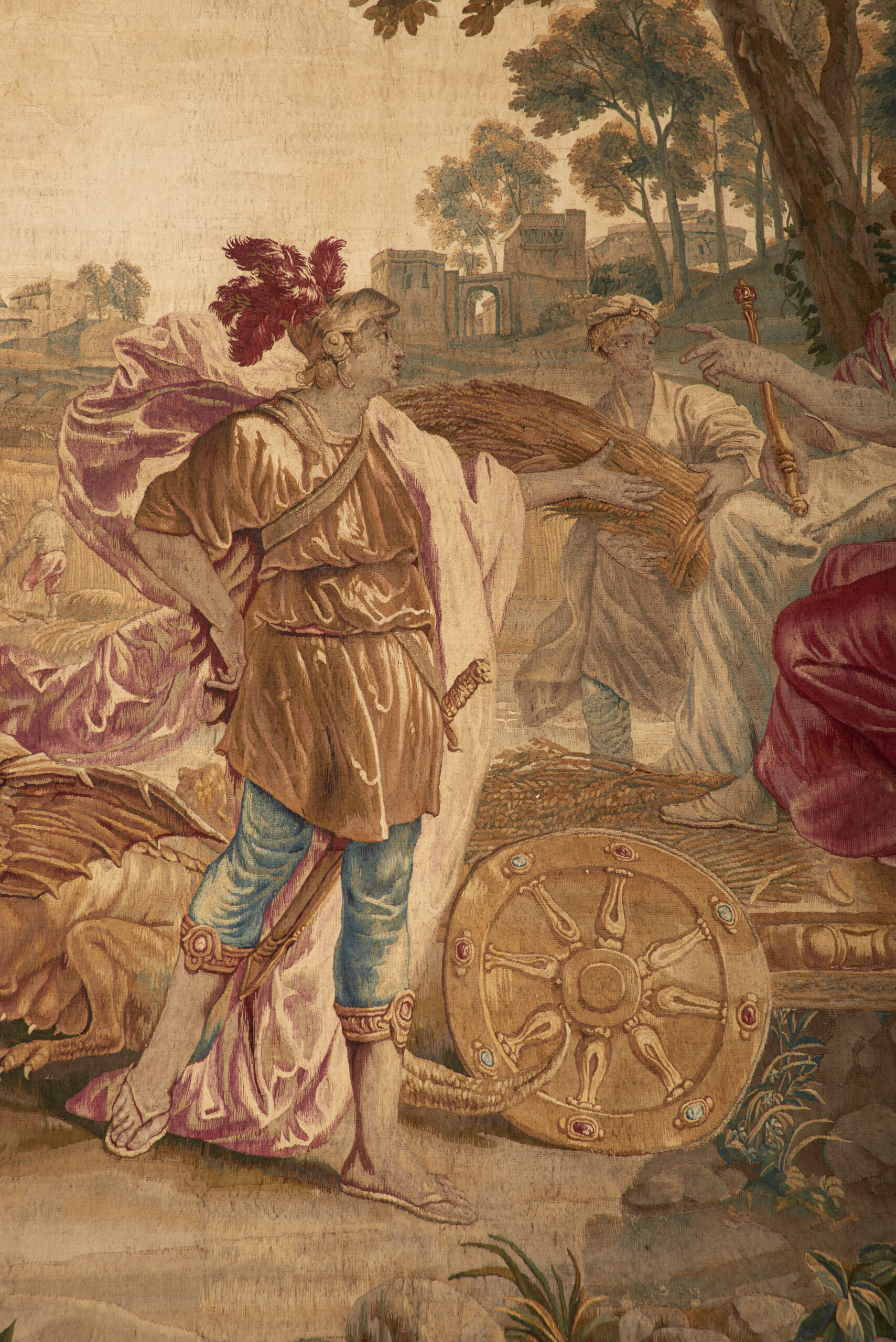
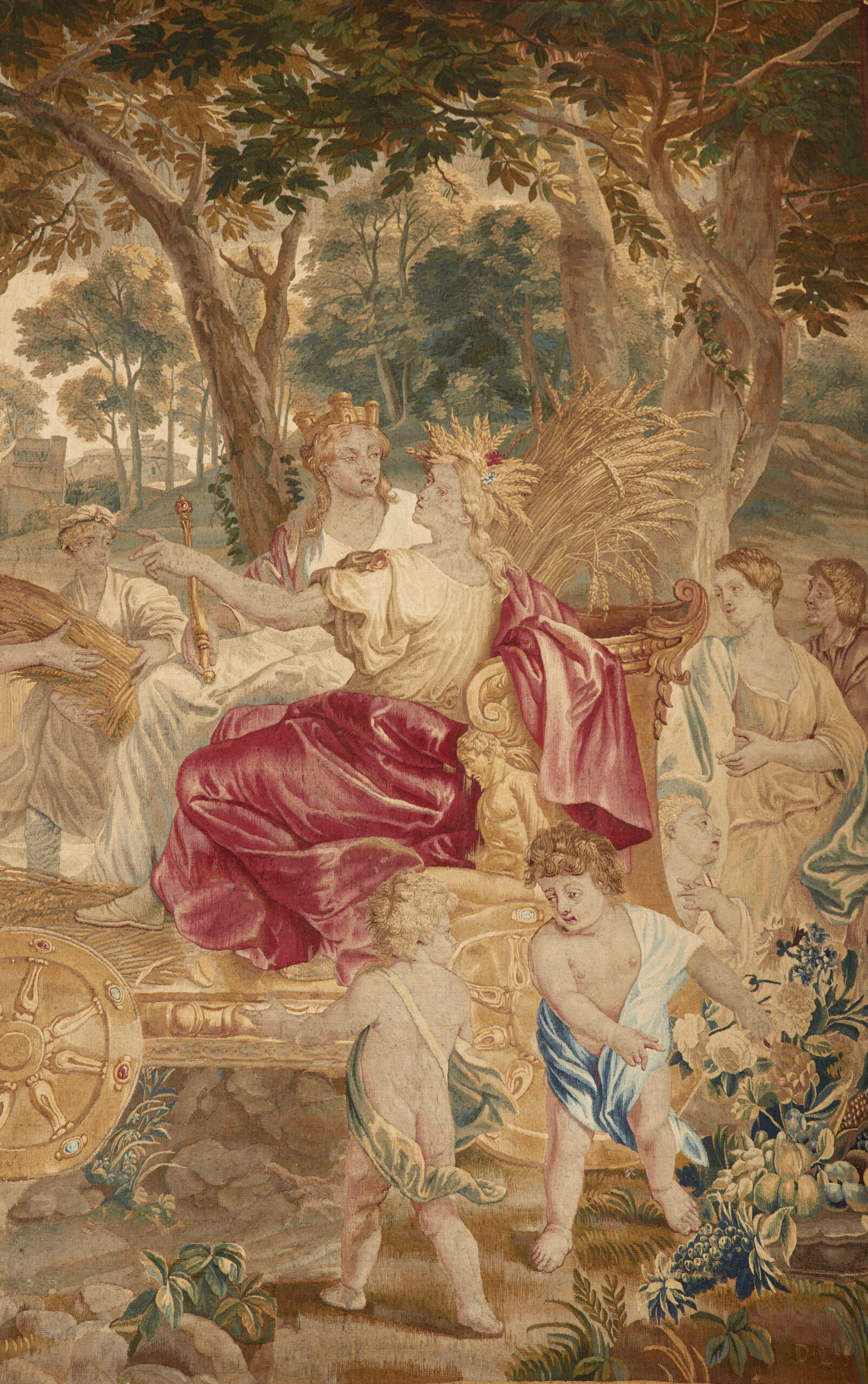
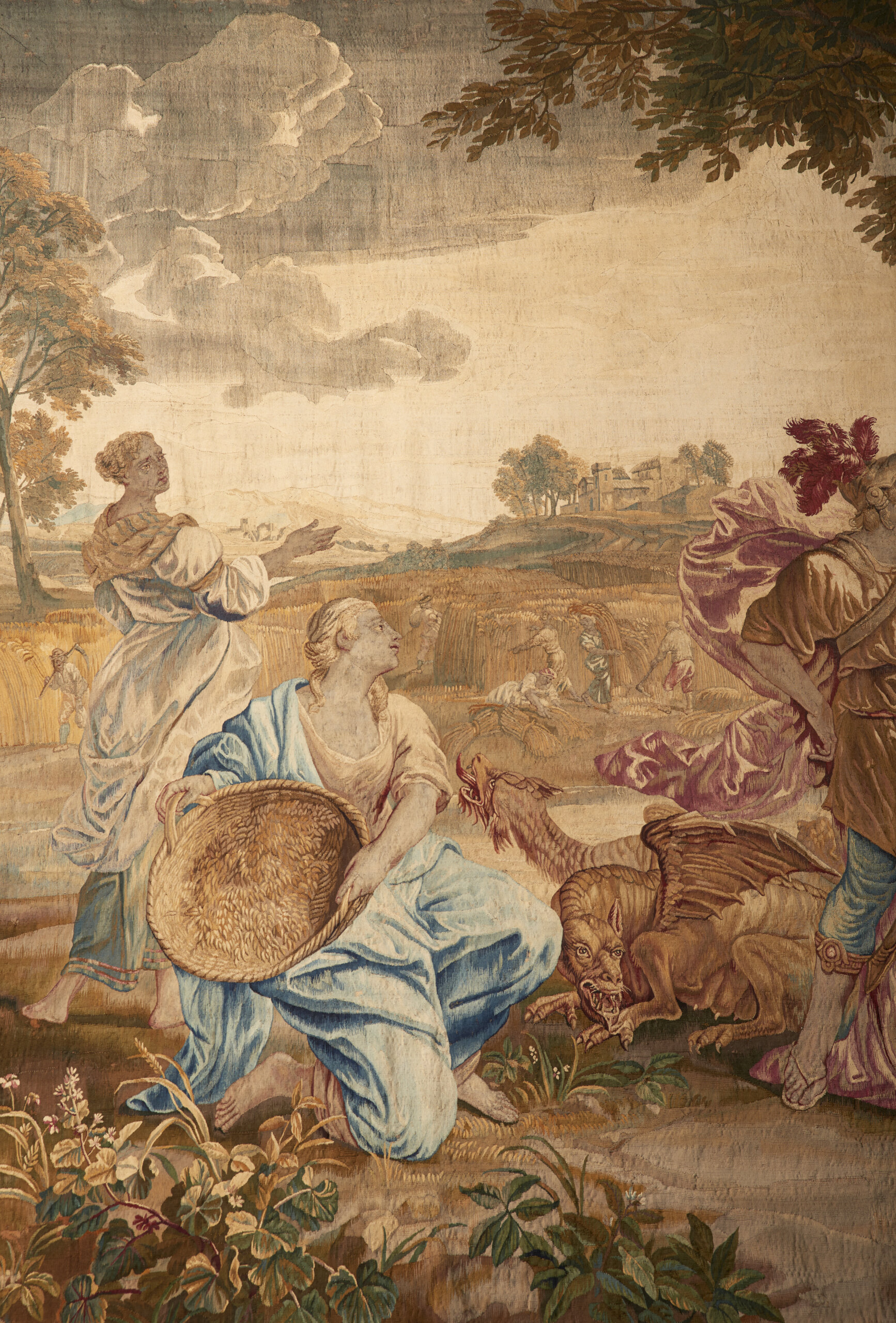
Depicting the goddess of agriculture and fertility, crowned with wheat ears and holding a sceptre, seated majestically in a partially visible triumphal chariot drawn by winged dragons. Ceres is accompanied by a retinue of nymphs, putti and a male figure in military attire.
To the left, a group of peasants is shown in an attitude of veneration. The background is filled with trees, architectural elements and rural scenes associated with the harvest.
Border composed of continuous acanthus scrolls, with cartouches centred on each side and at the corners
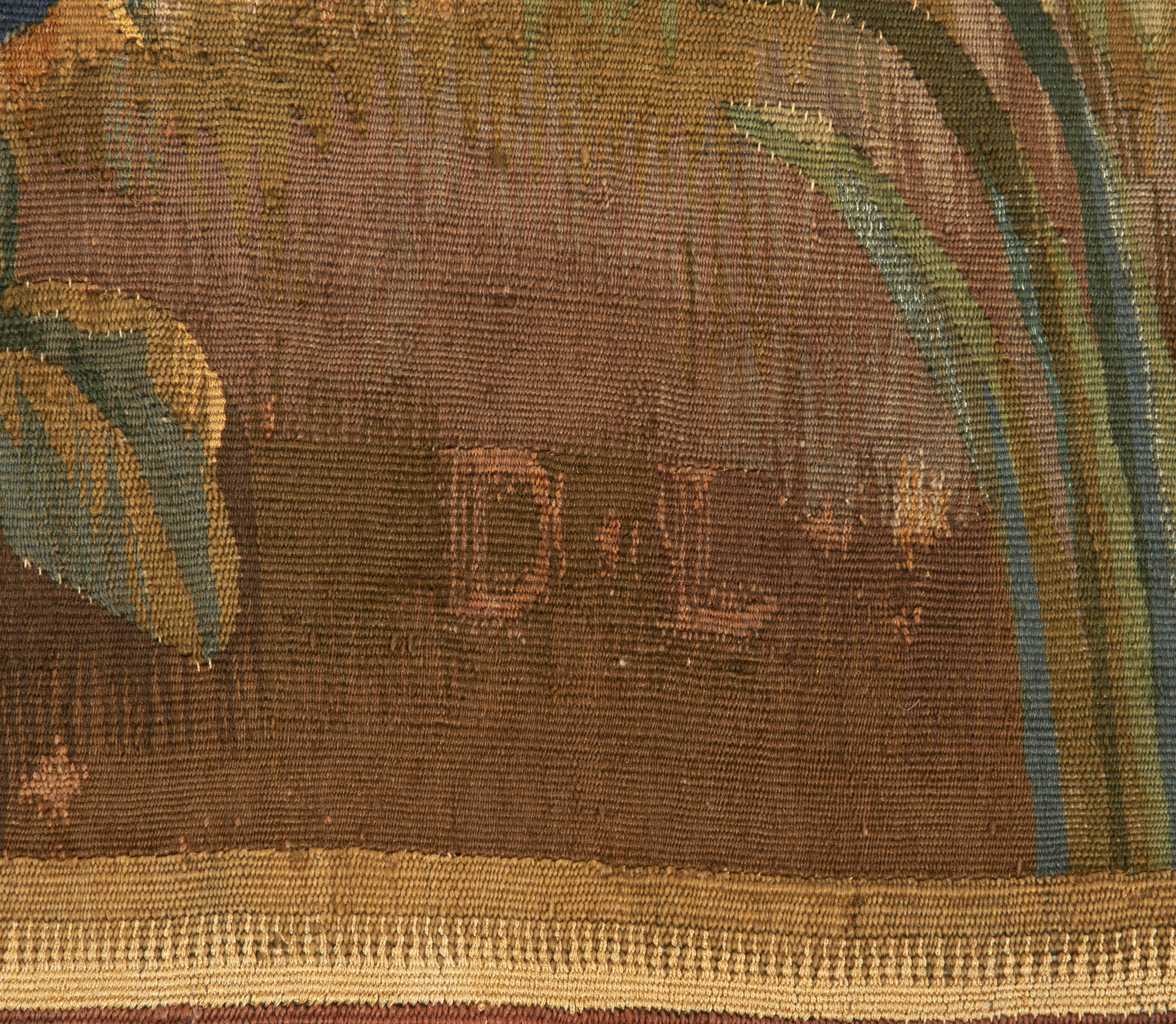
Signed “D. L.” lower right
Second half of the first half of the 18th century
(minor wear and small restorations)
349x410 cm
Additional Information
The Triumph of Ceres in Early Eighteenth-Century Brussels Tapestry
The present tapestry forms part of the mythological series The Triumph of the Gods and Goddesses, designed by Jan van Orley and Augustin Coppens and woven in the workshop of Urbanus and Daniel Leyniers (initially in partnership with Hendrik Reydams). This ambitious cycle stands among the most imposing mythological programmes produced in Brussels in the early eighteenth century. Two further series centred on the triumph of the classical gods are recorded: the first, dating to around 1705, designed by Victor Janssens with landscapes by Coppens and woven in the workshops of Judocus de Vos and the Auwercx family; and a third, also based on designs by Van Orley and Coppens, associated with the Van der Borcht workshop, active from about 1725 onwards (Campbell, 2007).
The earliest documented commission of the Reydams–Leyniers series was placed in 1716 by the Kasselrijhuis van Oudburg. The set, comprising five tapestries depicting Apollo, Minerva, Diana, Venus and Mars, was installed in the institution the following year, in 1717. Now preserved in the Museum voor Schone Kunsten in Ghent, it represents the earliest and most complete surviving edition of The Triumph of the Gods and Goddesses (MSK Gent). The Leyniers workshop continued to produce further editions of the series over several decades, assembling different combinations of deities as required; at least fourteen weavings are known between 1717 and 1747 (Campbell, 2007).
The full scope of the cycle is confirmed by Daniel Leyniers’ autobiographical papers of 1749, studied by Koenraad Brosens, in which he lists fifteen mythological compositions, each dedicated to a specific deity: Venus, Minerva, Mars, Mercury, Vulcan, Aeolus, Jupiter, Bacchus, Diana, Ceres, Flora, Apollo, Hercules, Pluto and The Bath of Diana (Brosens, 2004). This list confirms the existence of a composition devoted to Ceres within a coherent and courtly programme designed to convey abundance, fertility, virtuous rule and divine authority. That these subjects remained active in the workshop’s catalogue well into the mid-eighteenth century attests to the commercial viability and enduring prestige of Van Orley and Coppens’ designs.
Jan van Orley and Augustin Coppens had a defining impact on tapestry production in Brussels throughout the eighteenth century. Van Orley emerged early in the century as one of the leading cartoon painters, producing large-scale narrative series and establishing a figurative vocabulary that became widely adopted. Coppens, celebrated initially for his depictions of Brussels after the bombardment of 1695, became one of the most sought-after landscape designers for tapestry, active from 1689 and working with nearly all the major workshops. According to Campbell (2007), their collaboration was exceptionally prolific: they produced at least fifteen series together for the workshops of De Vos, Auwercx, Le Clerc, Van den Hecke, Reydams–Leyniers and Van der Borcht. Between roughly 1713 and 1725, they were the principal designers supplying the Reydams–Leyniers workshop (Campbell, 2007).
Their partnership relied on a clear division of labour: Van Orley established the narrative structure and figures, while Coppens added the landscape, providing the depth, scale and atmospheric setting characteristic of these works. In correspondence cited by Campbell (2007), Coppens explains that he completed the landscapes “after colleagues had finished the cartoons with figures and animals”, a working method repeated across numerous series, from the Metamorphoses of Ovid and the Hunting Scenes with Lodewijk van Schoor to the History of Jupiter with Johannes de Reyff, the Teniers series, and the great historical and mythological compositions woven by De Vos, Auwercx, Reydams–Leyniers, Van den Hecke and Van der Borcht (Campbell, 2007; Brosens, 2017). Although they remained independent artists rather than a formal joint workshop, many commissions were issued in Van Orley’s name and completed “with” or “after” Coppens; documentary evidence for the Teniers series woven by De Vos even states that “Coppens executed the landscapes on all eight cartoons” (Brosens & Slegten, 2017). The result was a body of fully articulated series that could be supplied to workshops ready for weaving and reissued in successive decades. Documentation from the mid-eighteenth century confirms that The Triumph of the Gods and Goddesses remained central to the Leyniers workshop’s output long after both artists had died. Records show that between 1751 and 1752, Daniel IV Leyniers sold seven tapestries from the series to the imperial ambassador Botta Adorno for presentation to Empress Maria Theresa of Austria (Brosens, s.d.).
The present tapestry, depicting the triumph of Ceres, belongs firmly to this creative and commercial context, reflecting the artistic ambition and longevity of a cycle that shaped Flemish tapestry production throughout the eighteenth century.
Known examples of The Triumph of the Gods and Goddesses in Portugal include The Triumph of Bacchus at the Casa-Museu Medeiros e Almeida and The Triumph of Minerva at the Palácio Nacional da Ajuda. In relation to the theme of Ceres, a tapestry attributed to the workshop of Albert Auwercx—sold at Sotheby’s, New York, 30 March 2011—displays a border strikingly similar to the one on the present lot. This similarity is noteworthy, as Brussels workshops generally sought to distinguish themselves through exclusive border designs (Campbell, 2007). Such proximity suggests that, during the decline of the Auwercx workshop in the 1720s–1740s, the flourishing Leyniers workshop may have acquired border cartoons originally belonging to the Auwercx family, a practice documented elsewhere in the period. The presence of this Auwercx-derived border on a tapestry signed “D.L.” therefore points to a weaving later than the earliest editions of the series and is consistent with a date in the 1730s, when the Leyniers workshop consolidated its dominant position in the market.
Literature:
Brosens, Koenraad. "Botta Adorno, Empress Maria Theresa and Brussels Tapestry. Part II." Textile History;
Brosens, Koenraad, e Astrid Slegten. "Creativity and disruption in Brussels tapestry, 1698–1706: New data on Jan van Orley and Judocus de Vos." The Burlington Magazine 159;
Campbell, Thomas P., et al. Tapestry in the Baroque: Threads of Splendor. New York: Metropolitan Museum of Art; New Haven: Yale University Press, 2007.
Museum voor Schone Kunsten Gent. "Verheerlijking van Diana, 1717." Ficha de inventário, Inv. 1994-F-4.
Closed Auction
