
10
The Four Continents
Jan Van Kessel I (1626-1679)
Estimate
200.000 - 300.000
Session 1
25 March 2026
Hammer Price
Register to access this information.Description
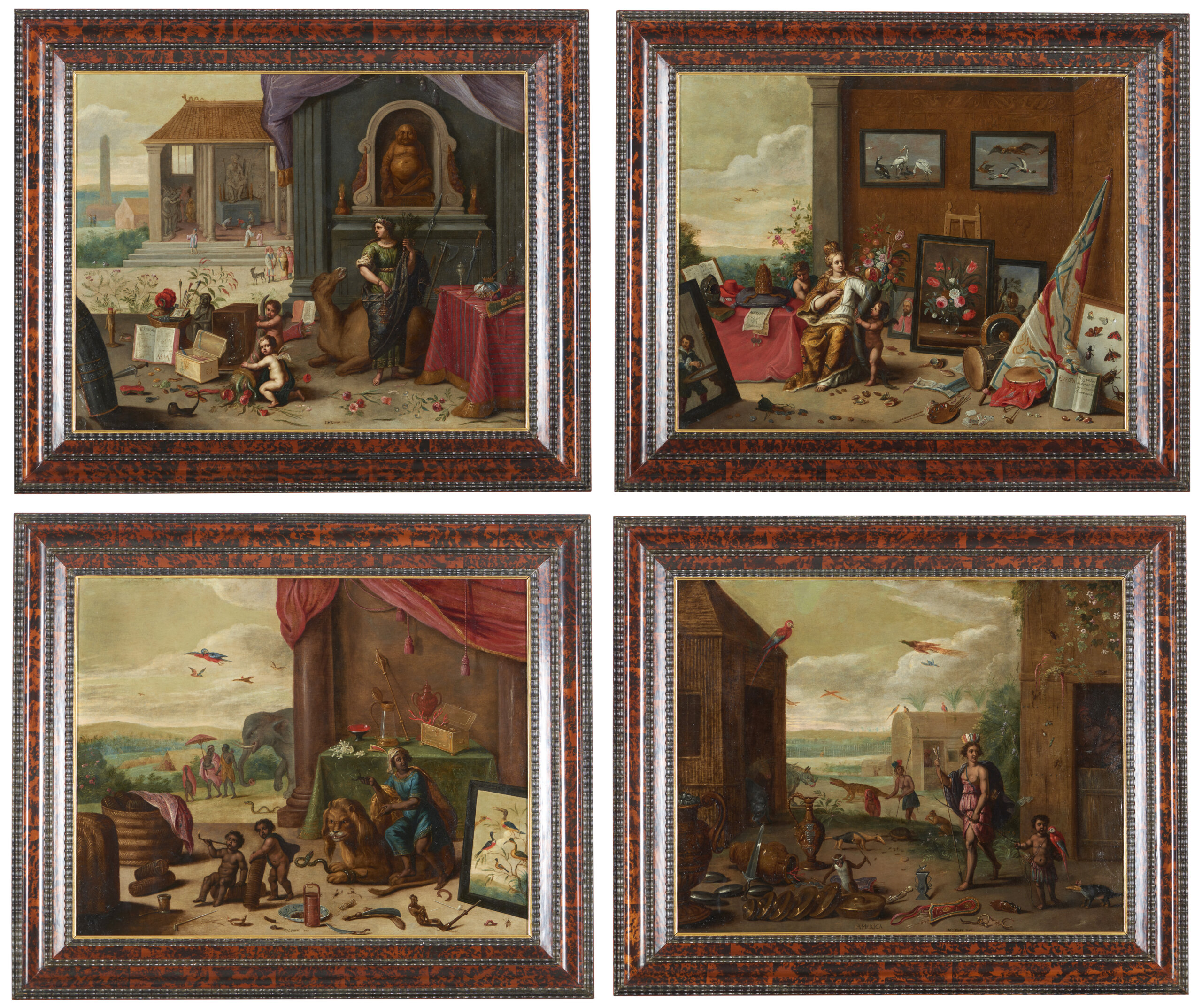
Four oils on copper
Each signed lower centre, “I.V. KESSEL. fecit”
69x87 cm (cada)
Category
Paintings
Additional Information
Provenance:
Collection at the Palacio Porto Covo, Lisbon
Auctioned in 1941 by Leiria & Nascimento, Lisbon
Private collection
Note about the Lot
Jan van Kessel was a third-generation member of the Antwerp Brueghel dynasty of painters. He was the only son of Hieronymus van Kessel (1578-1636 or later) and Paschasia Brueghel (1603-1626 or later), daughter of Jan Brueghel the Elder. He was trained by his maternal uncle Jan Breughel the Younger (1601-1678). Van Kessel was admitted to the Antwerp painters’ guild in the administrative year 1644-1645, specifically as a flower painter. His oeuvre is quite varied, both in subjects as in quality. On the one hand he was a highly original and inventive artist, on the other, he borrowed motifs and compositions from fellow artists at will and was occasionally rather repetitive. His best work dates from the years around 1650 up to about 1665 and includes an excellent set of at least eight floral still lifes from 1652, painted for export to Spain. Among his highly original works is a set of four allegories of the Four Continents from 1664, now in the Alte Pinakothek in Munich.(1) The fourth in that set, Africa, judging from the date, was completed in 1666. Those sets consist of four central panels, to which the four works offered here are closely related, each surrounded by sixteen smaller panels of landscapes with animals and (sometimes imaginary) city profiles in the distance. A second, incomplete series, from 1660, in the Prado Museum in Madrid now only consists of 40 smaller panels.(2) Van Kessel produced other such composite sets, for instance of insect studies.(3) This does not imply, however, that the set of Four Continents presented here must originally have belonged to such a compilation. They are larger than the other known examples, which would require surrounding panels of different measurements. No such panels appears to be recorded. Jan van Kessel’s series of continents can be seen in the context of the great general interest in a fast-expanding world, due to increasing connections and trade overseas, with a resulting influx of exotic products and tales into the wealthy European societies. Compact representations of all these novelties by skilled artists were a welcome product as conversation pieces in collectors’ cabinets.
All of the four panels presented here, except Africa, are inscribed with the names of the continents they represent, and include a(n allegorical) figure(s) symbolising the population. Van Kessel has filled the representations with animals and objects connected with the respective continent – although not all of them accurately. While these scenes are similar in type to the central panels of the Munich series, their details and construction differ. While the panels are larger, they are generally less elaborate than the earlier versions. This set is probably the latest in its sort produced by Jan van Kessel, the quality of whose work declined towards the 1670s. Probably several details were executed by painters assisting him in his studio. The figures, in at least three of the panels, were painted by Abraham Willemsen (see below).
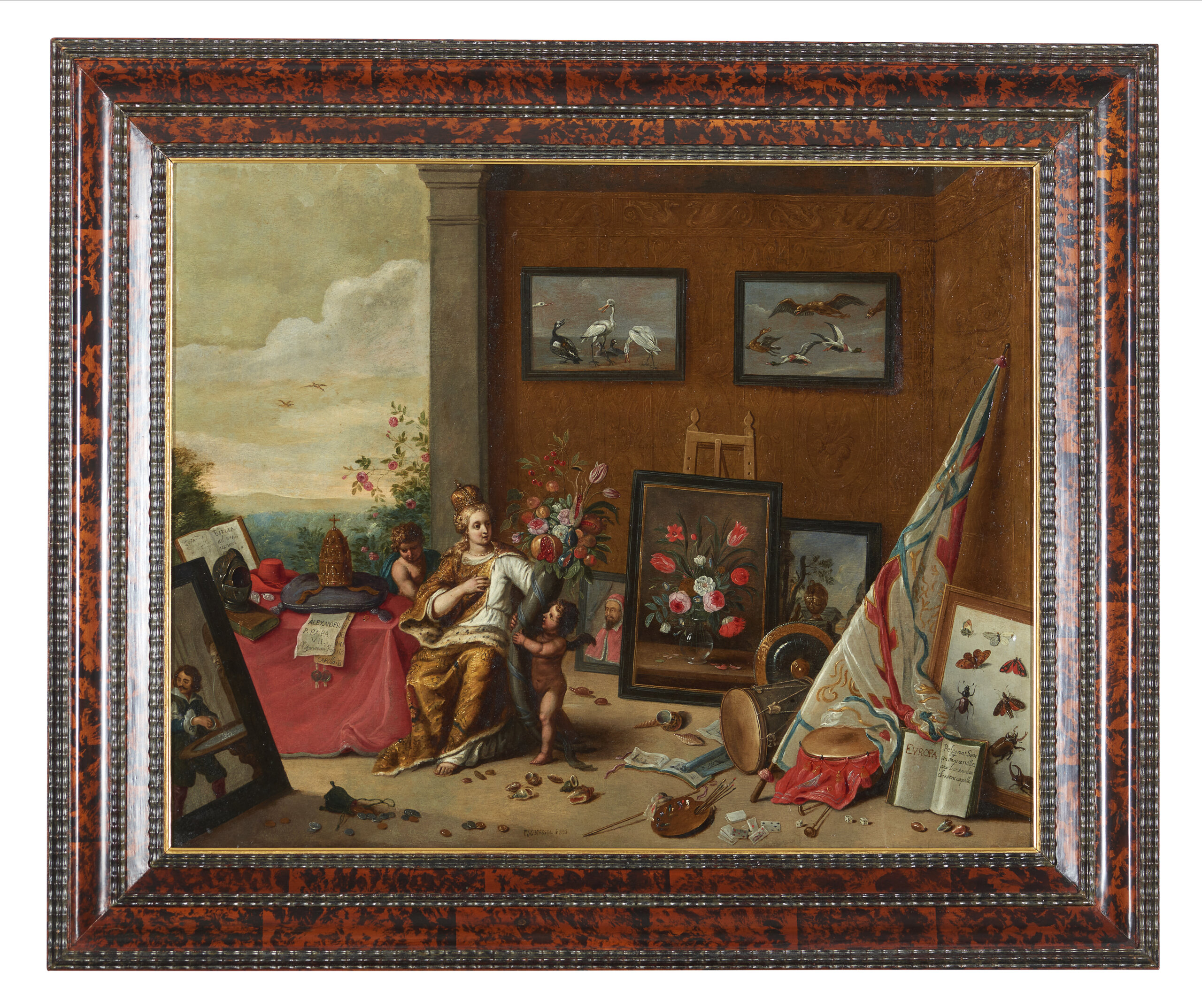
Europe, like in the Munich version, is represented by a crowned lady, holding a large cornucopia filled with fruit and flowers, symbolising the prosperity of the continent. The room is adorned with variants of some of van Kessel’s own paintings. The painting of waterfowl is an adaptation of the small panel inscribed ‘Stockholm’ in the Munich series, while the flying bird of prey in the other appears in at least two of his smaller panels.(4) Both the flower painting, reminiscent of the 1652 series mentioned above, and the insect study at lower right are rendered substantially larger than the actual type of paintings. The shield, banner and drums, as well as the helmet to the left, refer to Europe’s military power. The sketchbook, mahlstick, palette ad brushes imply the importance of art, the purse indicates monetary wealth, and the playing cards and dice emphasise the importance of good luck. Despite the Reformation, Europe is clearly presented as a Catholic continent – van Kessel himself was a catholic. On the table to the left are the papal crown and red cardinal’s hat, and the book under the helmet is most probably a Holy Bible. Like in the Munich version, a sealed document on the table mentions Pope Alexander VII. A portrait of this pope stands on the floor against the back wall.(5) Pope Alexander VII had died in 1667 and had been succeeded by Pope Clement IX, who, in 1670, was succeeded by Clement X. Strewn on the floor are many sea shells. Those were costly exotic rarities imported from far-away shores, but also, on the right page of the book at lower left, bearing the inscription ‘EVROPA’ we read: ‘Pelegrins Sont qui dans ces Villes pour leur bourdon [= pilgrim’s staff] chersent coquilles’. This refers to the pilgrims travelling to Santiago de Compostella collecting their pilgrim’s badges in the shape of shells on the way.
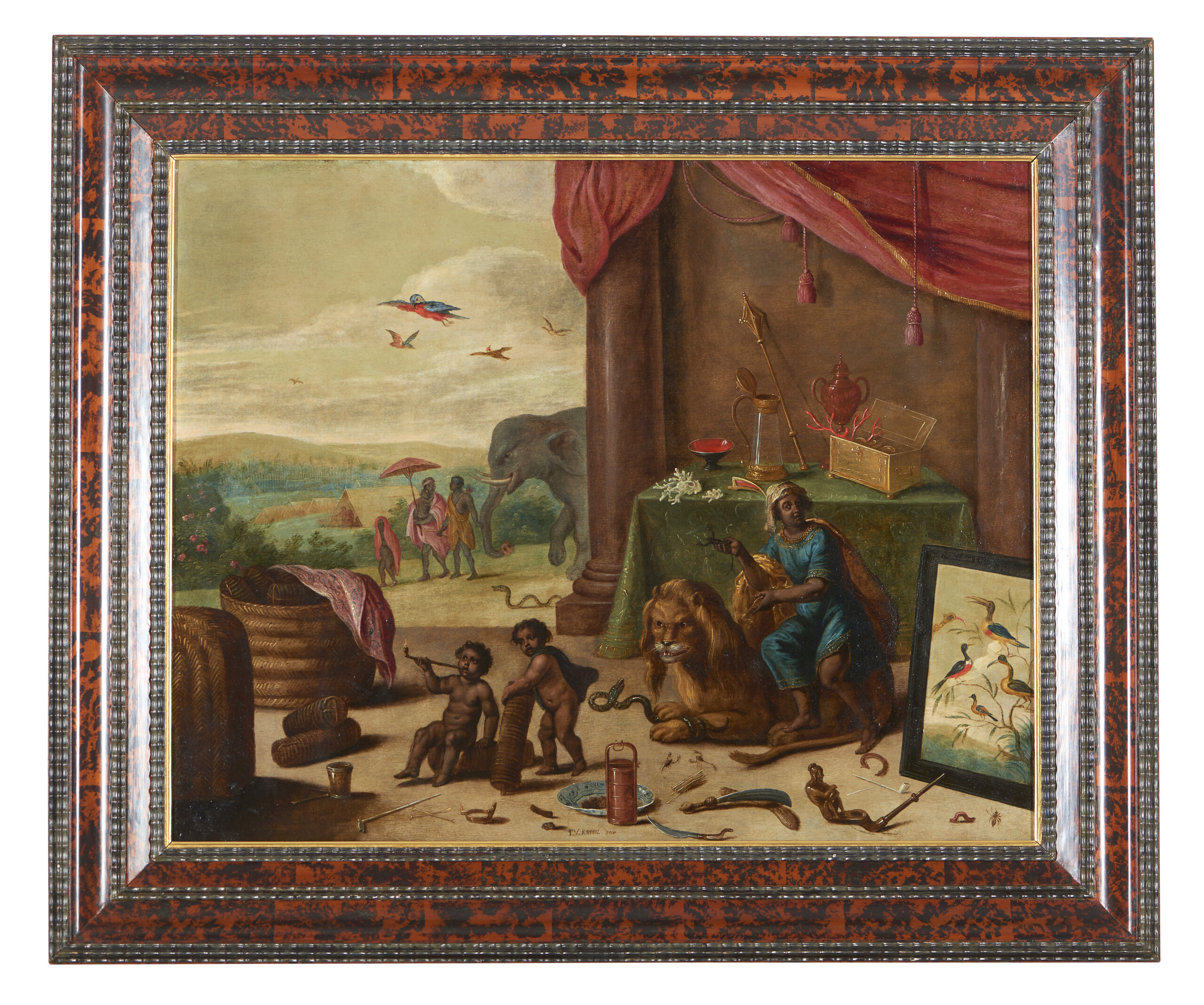
Africa shows a black woman holding a scorpion while sitting on a lion. The lion holds a snake between its front paws and two more scorpions are crawling in front of the animal , perhaps together indicating the dangers of African nature. To the left is a big basket of bails of tobacco, and in front are two black putti on a few more bails, one of which is smoking a pipe. On the floor in front is a variety of pipes, together with a Chinese porcelain dish of ground tobacco, as well as some exotic weapons. In the background, in front of a row of tents, a black family appears to be promenading an elephant. Exotic birds fly above them and at front right, we see a variant of one of Jan van Kessel’s paintings of exotic birds on a tree, largely inspired by his grandfather Jan Brueghel the Elder’s representations of the element Air. On a table placed against the back wall are some costly vessels, a sceptre and pieces of white and red coral.
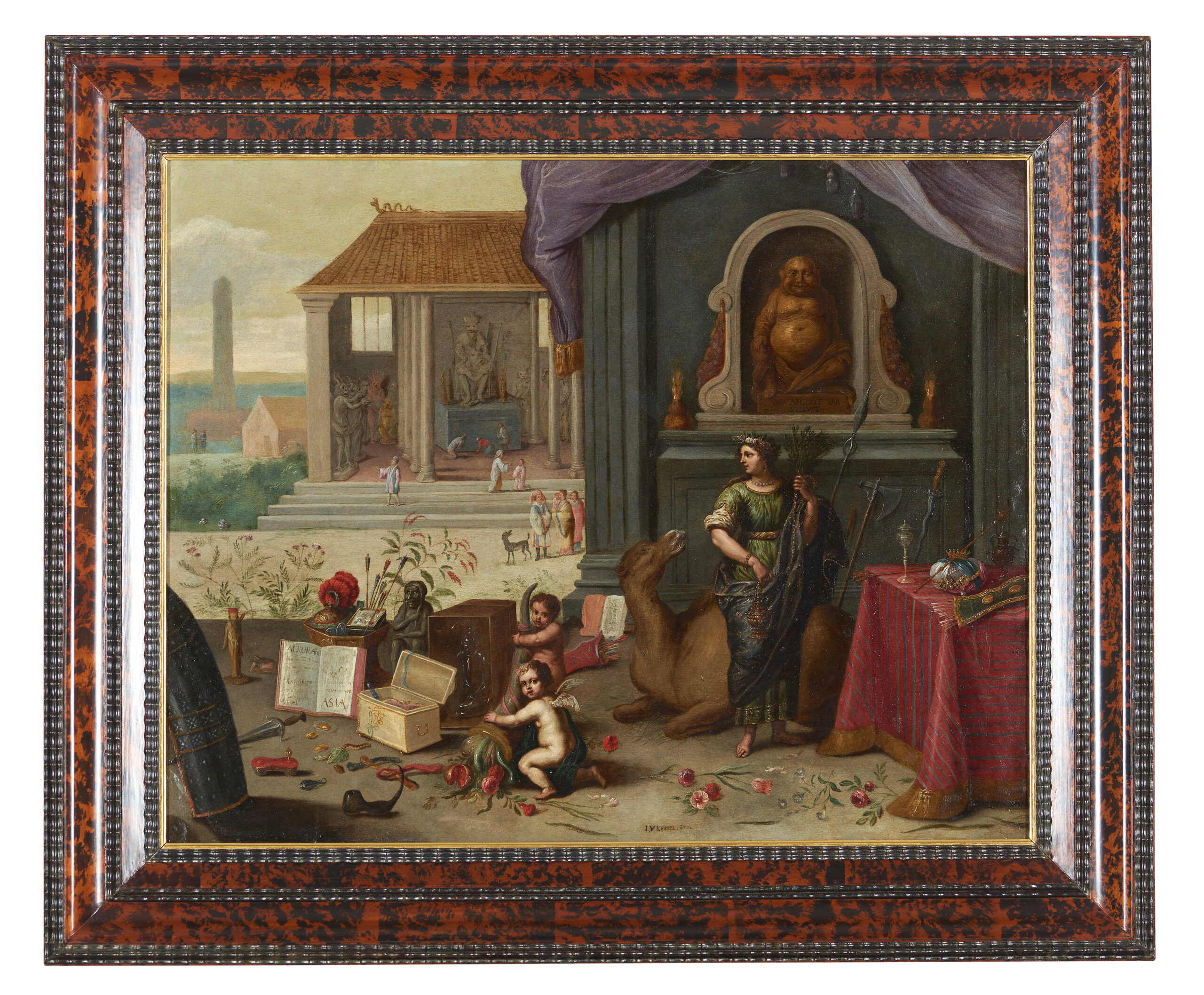
Asia shows a richly dressed woman holding an incense burner, she is crowned with a flower wreath. She is standing in front of a kneeling camel, to the left of a table upon which there are a crowned turban and a sceptre , some vessels and a quiver. Behind her is a large buddha in a niche, with exotic weapons leaning against it. At front centre, two cherubs are turning over a cornucopia beside a collection of exotic objects and valuables, including silkworms. An open book is inscribed at lower left ‘ASIA’, and a upper right ‘ALKORAN’, and further down ‘MAHOMETE’, referring to Islam.(6) To the far left stands what probably is a large shield, with a sword lying behind it. In left the background is a temple with figures worshipping idols. In the far left background is what may be a tower or an obelisk
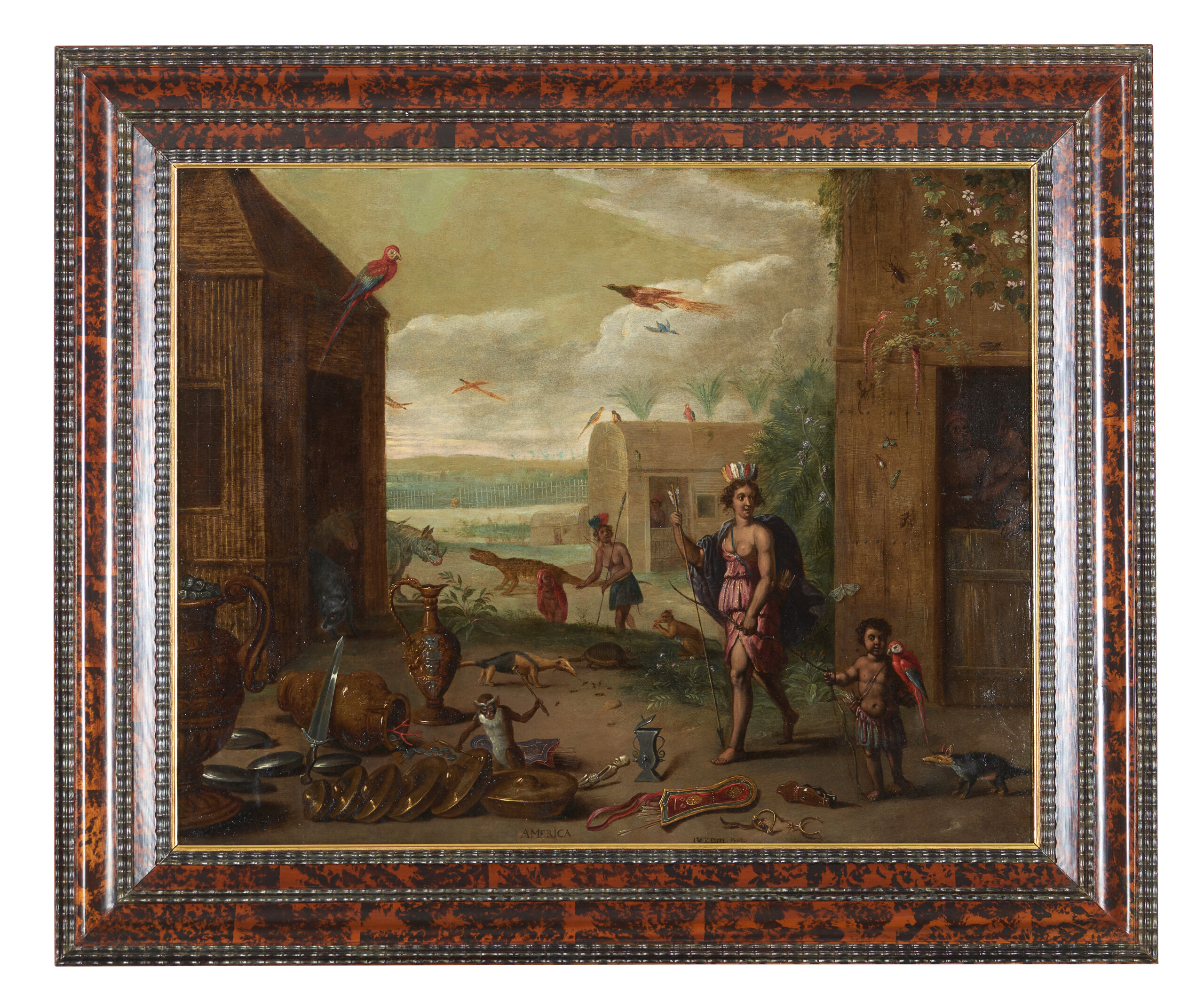
America is represented by coloured native Americans: a bare-breasted woman with a bow and arrows and a feather headdress, a similar figure in the centre background and a child in a feather skirt, holding a macaw and also with a bow and quiver. In the foreground, a monkey is hammering on a set of gongs lying on the floor. The animals in this painting include an armadillo, a turtle, an anteater, a kangaroo, a crocodile, and a rhinoceros, for which van Kessel employed Dürer’s famous etching of that animal.(7) On the roof of a shed to the left another macaw is perched, and there are several birds in flight, a bird of paradise among them. There are several exotic vessels, from one of which protrudes a piece of red coral, while a sword leans against it. The scene is set among huts within a fenced area. On the wall of the hut to the right, several creatures are crawling, among them another scorpion.
While the figures in the Munich series were contributed by the renowned artist Erasmus Quellinus II (1607-1678), for the present series Jan van Kessel collaborated with the less well-known figure painter Abraham Willemsen (1614-1672), an artist with whom he had worked more often, already in the 1650s. This collaboration dates the paintings to before December 1672, when Willemsen died. However, the figures in Asia are not fully characteristic of Willemsen’s style, so they may have been finished by a collaborator after the artist’s death. In any case, this would confirm a date of origin of the present four paintings after 1667 – in view of the Pope’s portrait – and before 1672 or slightly after.
Dr. Fred G. Meijer
Art Historian
Closed Auction
