
1
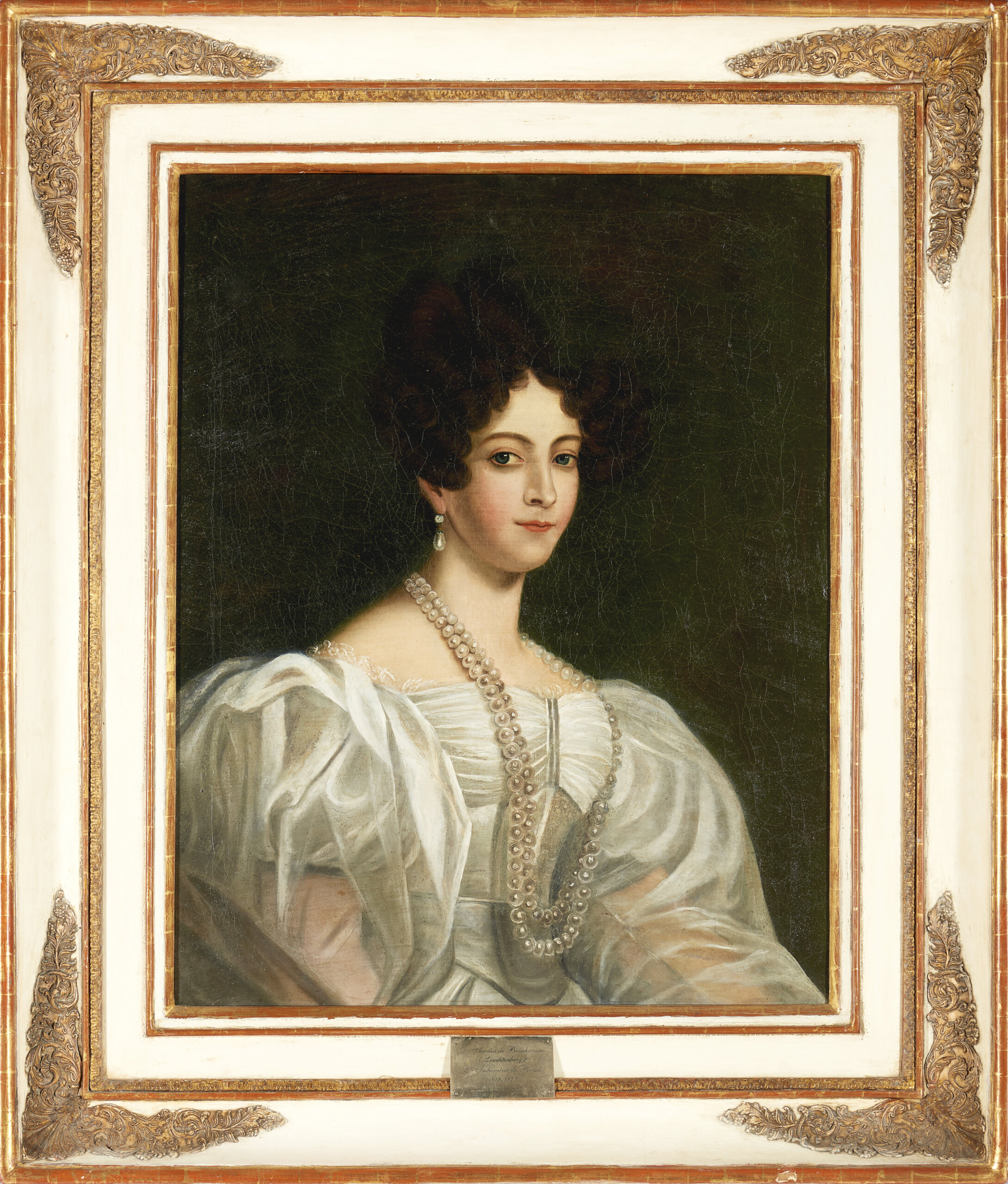
Portrait of Empress Amélia of Brazil, oil on canvas
Círculo de Joseph Karl Stieler (1781-1858)
Estimate
10.000 - 15.000
Session 1
2 June 2026
Hammer Price
Register to access this information.Description
Oil on canvas
81x64 cm
Additional Information
Portrait of D. Amélia Beauharnais Leuchtenberg, Empress of Brazil and wife of King Pedro IV of Portugal, and first Emperor of Brazil, half-length, turned three-quarters to the right, looking forward, after an engraving by Jean-Baptiste Aubry-Lecomte (1787-1858) held in the Pinacoteca de São Paulo.
Daughter of the then Viceroy of Italy, Eugène de Beauharnais, and Princess Augusta Amelia, daughter of King Maximilian I of Bavaria, D. Amélia was, on her paternal side, granddaughter of Josephine de La Pagerie, wife of Emperor Napoleon Bonaparte.
Educated in Munich, at the age of 17 she set off for Rio de Janeiro, with the purpose of marrying D. Pedro I of Brazil, widowed since 1826 of D. Leopoldina of Habsburg, and of becoming the second Empress of Brazil.
The empress would accompany her husband and her stepdaughter, D. Maria da Glória, to Europe, where the couple, now using only the title of Duke and Duchess of Bragança, would see the birth of their only daughter, Marie Amélie, on 1 December 1831.
Shortly thereafter D. Pedro departed for the Azores, only rejoining his wife and daughters in 1833.
With the death of D. Pedro in 1834, D. Amélia was widowed at the age of twenty-two, returned to Munich, and shortly afterwards returned definitively to Portugal. In Lisbon, she lived between the Palácio das Janelas Verdes, site of the present-day Museu Nacional de Arte Antiga, and the Real Quinta de Caxias, devoting her life to the poor and the sick, never losing contact with the stepchildren she had left behind in Brazil, children of D. Pedro's first marriage.
Among her best-known portraits is the one held in the collection of the Palácio Nacional de Queluz, in which the young Empress wears a dark blue velvet dress with an off-the-shoulder neckline while holding a medallion with the effigy of D. Pedro IV. Around her neck, she wears a pearl necklace with a drop-shaped pearl pendant, forming a set with pearl earrings similar to those she wears in the painting by Friedrich Dürck held in the Museu Nacional Soares dos Reis.
In this painting, on the other hand, the Empress wears a long double-strand pearl necklace and earrings similar to those in the painting at the Palácio de Queluz.
Closed Auction
