
68
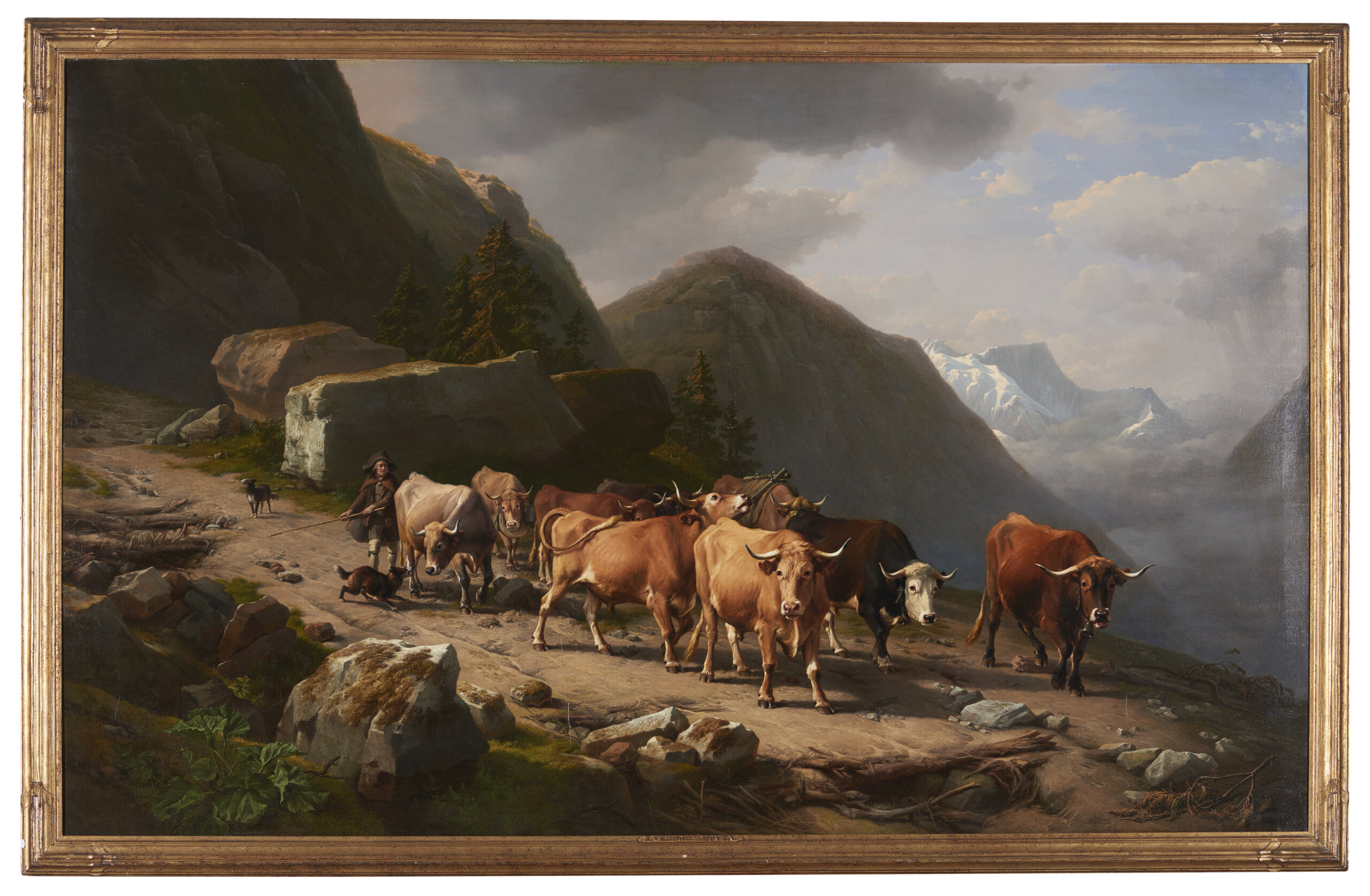
Landscape with shepherd, oxen and dogs
Eugène Verboeckhoven (1798/99-1881)
Estimate
15.000 - 25.000
Session 1
26 October 2026
Description
Oil on canvas
Signed and dated 1860
On the reverse, authentication of the work by the artist "Je soussigné déclare que le tableau ci contre est original / Eugène Verboeckhoven / Schaerbeek lez Bruxelles 1860"
145x231 cm
Category
Paintings
Additional Information
Literature:
Siegfried Wichmann, "E. Verboeckhoven 1799–1881. Ein flämischer Tiermaler des 19. Jahrhunderts". Sindelfingen, 1977, cover and p. 33
EUGÈNE VERBOECKHOVEN - Warneton, 1798 – Schaerbeek, 1881
Painter, draughtsman, engraver, lithographer and sculptor, Eugène Verboeckhoven achieved international renown above all as one of the foremost animal painters of the nineteenth century.
Sheep, cattle, goats, horses and donkeys occupy a privileged place in his œuvre, alongside dogs, deer, rabbits, hares and poultry, as well as more exotic and wild animals. His desire for accuracy was such that he is said not to have hesitated to enter animals’ enclosures in order to observe them at close quarters.
These animals inhabit luminous, bucolic landscapes, atmospheric winter hunting scenes, farmyards and, occasionally, coastal settings. Whether working on an intimate scale or on large and ambitious canvases, Verboeckhoven maintained a remarkable attention to detail. His small-format paintings, in particular, often possess the refinement and precision of miniature jewels, while his larger compositions display the same meticulous execution throughout.
Although celebrated principally for his animal subjects, Verboeckhoven was also an accomplished portraitist and painted, among others, King Leopold I of Belgium.
During his lifetime, Verboeckhoven ranked among the most celebrated Belgian artists of his generation and enjoyed a truly international reputation. His paintings entered collections not only in Belgium, but throughout the Netherlands, Germany, France, Italy, Portugal and Great Britain, as well as Russia, the United States and South America.
Today, his works are represented in numerous public collections, including museums in Brussels, Antwerp, Ghent, Kortrijk, Liège, Luxembourg, Valenciennes, The Hague, Berlin, Stockholm, Munich and Frankfurt, as well as major international institutions in Paris, St Petersburg and Amsterdam.
An Artist Formed by Sculpture
Eugène Verboeckhoven grew up in a family of artists. His father, Barthélemy Verboeckhoven, was a sculptor and provided his son with his earliest artistic training, teaching him not only drawing but also modelling and sculpture.
This sculptural foundation would prove fundamental to Verboeckhoven’s development as a painter. His remarkable understanding of volume, anatomy and three-dimensional form can be felt throughout his œuvre, particularly in the powerful physical presence he gives to his animals.
At a young age, he attended classes at the Academy of Ghent and subsequently became associated with several of Belgium’s leading artistic institutions.
From early in his career, Verboeckhoven looked to the great Old Masters, absorbing their technical knowledge and compositional traditions while developing a language that remained unmistakably rooted in nineteenth-century Romanticism. His paintings combine meticulous observation with an idealised vision of the natural world.
A perfectionist by temperament, he delighted in introducing minute and charming details: a salamander beside a rock, a lively magpie perched on a branch, drops of morning dew upon leaves, or a butterfly caught momentarily in the landscape. Such details are never merely decorative; they contribute to the extraordinary sense of life that animates his compositions.
Verboeckhoven was an observer of exceptional precision. He produced a considerable number of drawings and studies from nature before undertaking the finished painting. Individual observations could then be brought together within a carefully constructed composition, creating an idealised whole in which nature appears more harmonious, serene and perfectly ordered than reality itself.
His art thus occupies a fascinating territory between observation and idealisation, realism and Romanticism.
The Individuality of the Animal
One of the most distinctive and appealing qualities of Verboeckhoven’s art is his ability to individualise his animals.
A flock of sheep is never simply an anonymous group. One animal may turn towards the viewer; another quietly chews the cud; a ram stands proudly erect while a lamb seeks the protection of its mother. Each occupies its own space and appears to possess its own temperament.
Through such subtle differentiation, Verboeckhoven endowed his animals with an unusual dignity and individuality.
It was this exceptional mastery of animal painting that earned him the celebrated sobriquet “Raphaël des moutons” — “the Raphael of sheep.”
The comparison was intended as a tribute to the refinement, harmony and technical mastery he brought to a genre of which he had become one of the most accomplished European practitioners.
A Remarkable Technique
From a purely technical standpoint, Verboeckhoven was a painter of exceptional skill.
His treatment of wool is particularly characteristic. Viewed at close range, the fleece is often composed of innumerable small touches of the brush and subtle variations of tone. Seen from a greater distance, these individual marks coalesce, creating a remarkably convincing impression of softness, weight and volume.
The luminous skies that stretch above many of his pastoral landscapes are equally characteristic. Verboeckhoven's attachment to the techniques of the Old Masters extended, according to tradition, to the preparation of his materials: rather than relying exclusively upon modern pigments, he is said to have prepared ultramarine from ground lapis lazuli in pursuit of the intense blue he sought for his skies.
The extraordinary finish of his paintings should not, however, obscure the importance of drawing to his practice. His numerous studies reveal an artist constantly observing, analysing and recording the world around him. These drawings formed a repertoire of poses, animals, landscapes and details that could later be transformed and recombined within finished compositions.
An International Career
Verboeckhoven exhibited at the Ghent Salon in 1820 and, over the following decades, participated regularly in important exhibitions and Salons. In 1827, he settled in Brussels, which would become the centre of his professional life.
His success was accompanied by numerous distinctions. He received medals at exhibitions in cities including Ghent, Paris and Lille and was appointed an Officer of the Order of Leopold. In 1845, Queen Maria II of Portugal appointed him to the Order of Christ.
His reputation extended well beyond Belgium. During a journey to Italy, King Ludwig I of Bavaria commissioned a work from him, and Verboeckhoven was subsequently honoured with the Bavarian Order of Saint Michael.
Travel played an important role in his artistic development. He journeyed through France, Great Britain and Scotland — whose rugged coastlines particularly attracted him — as well as Germany, Switzerland and Italy. The Roman Campagna proved especially inspiring. Throughout these travels, he made drawings and studies that would later provide material for his paintings.
By this stage his reputation was such that fellow artists frequently invited him to contribute animals, and occasionally figures, to their compositions. Far from unusual in the nineteenth century, such collaboration reflected an artistic culture in which painters with different specialisations could combine their respective skills within a single work.
Verboeckhoven collaborated with some of the leading landscape painters of his time, contributing horses, cattle, sheep, goats, dogs and figures to landscapes by artists such as Louis-Pierre Verwée, Jean-Baptiste De Jonghe, Barend Cornelis Koekkoek, Alexandre Calame and Johann Bernard Klombeck.
He also collaborated with his brother, the marine painter Louis-Charles Verboeckhoven, adding figures and animals to his finely observed coastal and maritime compositions.
As a teacher, Verboeckhoven trained numerous pupils and followers and exerted a considerable influence upon the succeeding generation of Belgian animal painters, among them artists such as Daniel-Robert Jones and Charles and Edmond Tschaggeny.
Verboeckhoven and the Belgian Revolution
Verboeckhoven's career also coincided with a decisive period in Belgian history. He participated in the events surrounding the Belgian Revolution of 1830 and, following the Revolution, was entrusted by the Provisional Government with responsibilities connected with the administration of the Brussels museums, where he contributed to measures intended to safeguard works of art.
His position within the newly established Belgian state therefore extended beyond his success as a painter. He became part of the cultural establishment that emerged in Belgium after independence and participated actively in the artistic institutions of the new nation.
In 1834, Verboeckhoven became a Freemason in Brussels. From around 1850, three dots arranged in a triangular formation — a traditional Masonic sign — can be found accompanying his signature on certain works.
In December 1845, he was elected a member of the Royal Academy of Sciences, Letters and Fine Arts of Belgium, further confirming the prominent position he occupied within the country's artistic life.
A Singular and Enduring Style
Verboeckhoven remained remarkably faithful to his artistic principles throughout his long career. At a time when European painting was undergoing profound transformation, his work retained the meticulous technique, idealised naturalism and devotion to finish that had established his reputation.
Rather than following the increasingly radical developments that would eventually lead towards Impressionism, he continued to cultivate a highly personal synthesis of Old Master technique, Romantic sensibility and close observation of nature.
His consistency should not be mistaken for repetition. Within an apparently traditional vocabulary, Verboeckhoven continually varied poses, expressions, landscapes, atmospheric effects and relationships between animals. His extraordinary technical command allowed him to transform familiar pastoral subjects into carefully orchestrated compositions in which every detail contributes to the whole.
Dogs held a particularly important place in his œuvre. Verboeckhoven evidently shared this affection with King Leopold I, for whom he painted several canine subjects.
A particularly fascinating connection exists between A Newfoundlander Resting by its Kennel, painted in 1844, and The Favourite Animals of King Leopold I, executed the following year and preserved in the Belgian Royal Collection. The Newfoundland depicted in the earlier composition appears again in the royal painting, which was commissioned by Leopold I himself.
The relationship between the two works offers a compelling insight into Verboeckhoven's practice. The 1844 painting is not simply an accomplished portrait of a dog: it belongs to the artistic context that led directly to one of his important royal commissions.
Across a career spanning more than half a century, Eugène Verboeckhoven transformed animal painting into a field of extraordinary technical refinement. Combining the precision of the draughtsman, the understanding of volume of the sculptor and the sensibility of the Romantic painter, he created an idealised natural world in which animals are not secondary accessories but protagonists in their own right.
It was this combination of observation, virtuosity and individuality that established his international reputation during his lifetime and continues to make his finest works immediately recognisable today.
Viviane Berko
Can’t attend the saleroom?
Bid by Telephone or place and Absentee Bid
Telephone Bidding
Bidding by phone, which can be requested by the buyer, by previously indicating which lots he/she wants to bid on the phone, as well as indicating the telephone number(s) through which he/she can be contacted with a minimum of a 3-hour notice before the auction starts. A phone bid implies that the buyer is committed to at least cover the minimum estimate on the portfolio.
Absentee Bidding
Written bidding, giving the auctioneer full powers to bid on behalf and at the expense of the potential buyers who explicitly request it on an appropriate form that should be filled in according to the instructions there listed, namely the maximum bid amount offered for each lot, if this form is received at least 3 hours before the auction starts.
Lot added to your bidding order.
Back to lots page