
510
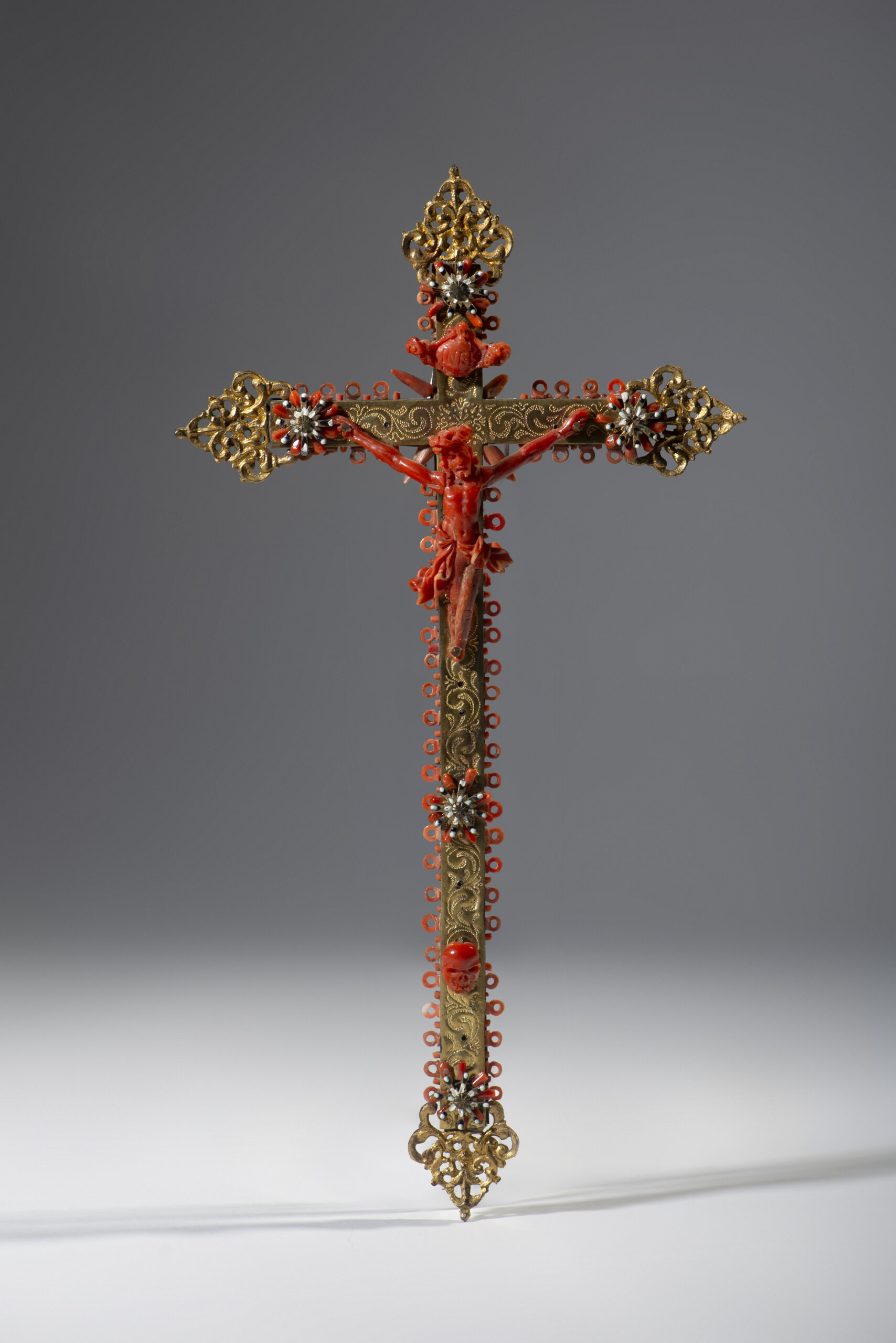
Christ crucified
Estimate
12.000 - 15.000
Session 3
27 October 2026
Hammer Price
Register to access this information.Description
Mediterranean red coral, gilt copper and gilt bronze, and enamel
Coral figure of Christ applied to a chiselled gilt copper cross
Terminals in cut-out and pierced gilt bronze
Decorated with coral and enamelled copper rosettes and a festooned coral frieze
Titulus and skull in coral
Trapani, Sicily, first half of the 17th century
(left arm and legs fractured, minor damage and losses)
30x17 cm
Category
Objects
Additional Information
Provenance:
Exhibitions:
Literature:
Note:
The production of coral works in Trapani is part of a long-standing tradition whose excellence was recognised throughout Europe. These objects were appreciated by nobles, high-ranking prelates, sovereigns and popes, and frequently formed part, not only of important diplomatic gifts, but of princely Kunstkammern as well. Their rarity contributed to their attributed high value, particularly in the context of the growing European interest in the Natural Sciences from the sixteenth century onwards.
The mythological origins of coral date back to Classical Antiquity and are recounted in Ovid’s Metamorphoses: when Perseus beheaded Medusa, the blood that flowed from her head turned into coral upon touching the ground. This association endowed coral, from an early date, with magical, protective and medicinal properties. Later reinterpreted within a Christian framework, coral came to be associated with the blood of Christ, also acquiring salvific significance[1].
Highly prized, coral was used in the creation of works of art across Europe. Among these, Trapani emerged as the foremost centre for its production, with its workshops benefiting from the support of the Viceroy’s court in Sicily between the sixteenth and eighteenth centuries.
The coral works production was favoured by the proximity of coral beds and an active trading network, which contributed to its expansion. Initially, production appears to have focused primarily on coral beads intended for the characteristic paternosters[2]. The craft subsequently developed through sustained artistic exchange and collaboration, with copper founders, goldsmiths and silversmiths sharing techniques and expertise. This interaction between different crafts contributed to the creation of objects of considerable technical complexity and ornamental richness[3].
A decisive moment in the evolution of this production occurred in the sixteenth century, with the introduction of the burin by Antonio Ciminello, a celebrated coral master. This tool enabled a greater degree of precision, facilitating the creation of small sculptures and miniatures of exceptional refinement.
At the end of the sixteenth century, the retroincastro[4] technique became widespread, becoming a defining feature of Trapani coral work, particularly in pieces dating from the late sixteenth century to the first half of the seventeenth century. It was frequently combined with white or polychrome enamels[5], as can be perceived in the small group of works now offered at auction. The technique consists of inserting small fragments of polished coral through the reverse of previously perforated gilt-copper plates. The fragments were secured with pitch and wax, then sealed with fabric, before the reverse was covered with a second gilt-copper plate[6]. As demand for these works increased throughout the seventeenth century, artisans gradually modified their methods, securing the coral elements with metal wires instead. The scale of this activity is further evidenced by the twenty-five workshops operating in Trapani at the beginning of the seventeenth century.
Trapani’s production of devotional works in coral developed within a context deeply shaped by the spirituality of the Counter-Reformation. In response to the Protestant Reformation, the Council of Trent (1545–1563) reaffirmed the role of religious images in Catholic worship, emphasising their importance in fostering devotion and communicating the principles of the faith. In the post-Tridentine period, this spiritual renewal was particularly evident in the intensification of Marian devotion, actively encouraged by the papacy and the Catholic Church[7].
The devotional plaque known as a capezzale[8], now offered at auction, fits within this framework, bringing together material, iconography and devotional function in a single composition. The representation of the Virgin reflects the importance of Marian devotion in the post-Tridentine period, whilst coral, associated in the Christian tradition with the blood of Christ, lends the work an apotropaic and salvific dimension. Its use therefore extends beyond its aesthetic or ornamental qualities, contributing directly to the devotional significance of the piece.
This dimension is even more evident in the crucifixes now offered at auction. The depiction of Christ in His final moments, marked by physical suffering and an expression of intense pain, reflects the post-Tridentine emphasis on making the episodes of the Passion visually immediate and emotionally accessible to the faithful. In one of these works, the coral incorporated into the figure of the suffering Christ establishes a direct visual association between the red material and the blood shed during the Passion. Coral thus acquires a particularly powerful significance, evoking Christ’s suffering and sacrifice, as well as His redemptive power[9]. The combination of the figure’s expressive intensity and the vivid colour of the coral transforms these works into objects intended not merely for contemplation, but also for the emotional and spiritual engagement of the viewer.
Thus, the capezzale and the two crucifixes, although distinct in their iconography and typology, share the same devotional foundation. Through the association between coral, the blood of Christ, suffering, protection and salvation, these works bear witness to the importance coral assumed in the religious art of Trapani during the seventeenth century.
Finally, it is significant to note the distinguished provenance of the larger crucifix, having formed part of the March Collection, one of the most significant Spanish collections of the twentieth century. Assembled over several generations of the March family, the collection was substantially expanded by Bartolomé March Servera (1917–1998), under the guidance of Pierre Delbée (1900–1974), whose taste was inspired by the Wunderkammern of the sixteenth and seventeenth centuries[10]. In 2009, a significant part of the collection was sold at auction by Christie’s, in London. A second sale followed in Paris on June 16th, 2015, where the crucifix now offered at auction was included.
Marta Silva Pereira
[1] See DI NATALE, Da Trapani a Napoli, p. 3; ASCIONE, Splendori di Sicilia, p. 104.
[2] See DI NATALE, I Grandi Capolavori del Corallo, pp. 39–42; DI NATALE, Rosso Corallo, p. 17; MARE, Mirabilia Coralii, p. 54.
[3] See DI NATALE, Rosso Corallo, p. 21.
[4] Term established by Corrado Maltese and Maria Concetta Di Natale in the context of the exhibition The Art of Coral in Sicily, held at the Pepoli Museum, Trapani, in 1986.
[5] See DI NATALE, Da Trapani a Napoli, p. 4.
[6] See INTORRE, Coralli trapanesi nella collezione March, pp. 31–32.
[7] See FASTIGGI, The Oxford Handbook of Mary, pp. 454–467.
[8] In Sicily, the term capezzale refers to a devotional plaque frequently hung beside the bed headboard, serving an apotropaic function (See CAMPIONE, Grandi Capolavori del Corallo, p. 81).
[9] See DI NATALE, Grandi Capolavori del Corallo, p. 10; MARINO, Grandi Capolavori del Corallo, pp. 114–115.
[10] See INTORRE, Coralli trapanesi nella collezione March, p. 31.
Closed Auction
