
642
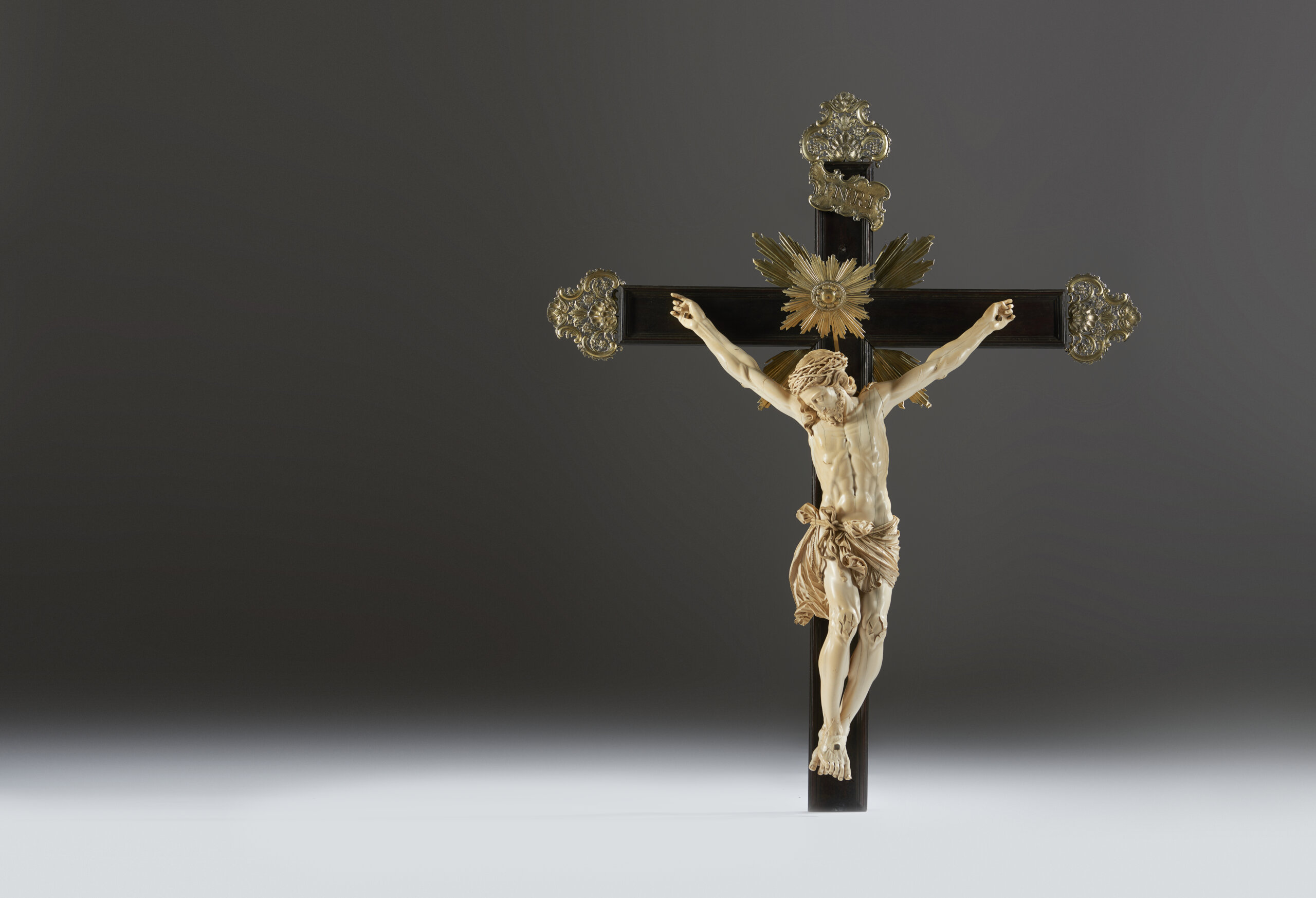
An excepcional Christ Crucified
Estimate
200.000 - 300.000
Session 3
16 October 2025
Hammer Price
Register to access this information.Description
Ivory sculpture
Ebony cross with silver mounts unmarked
Italy, probably Naples, ca. 1700-1730
(minor losses and defects)
76x63 cm (Christ)
119x82 cm (total)
Category
Objects
Additional Information
With the CITES certificate no. 25PTLX04466C
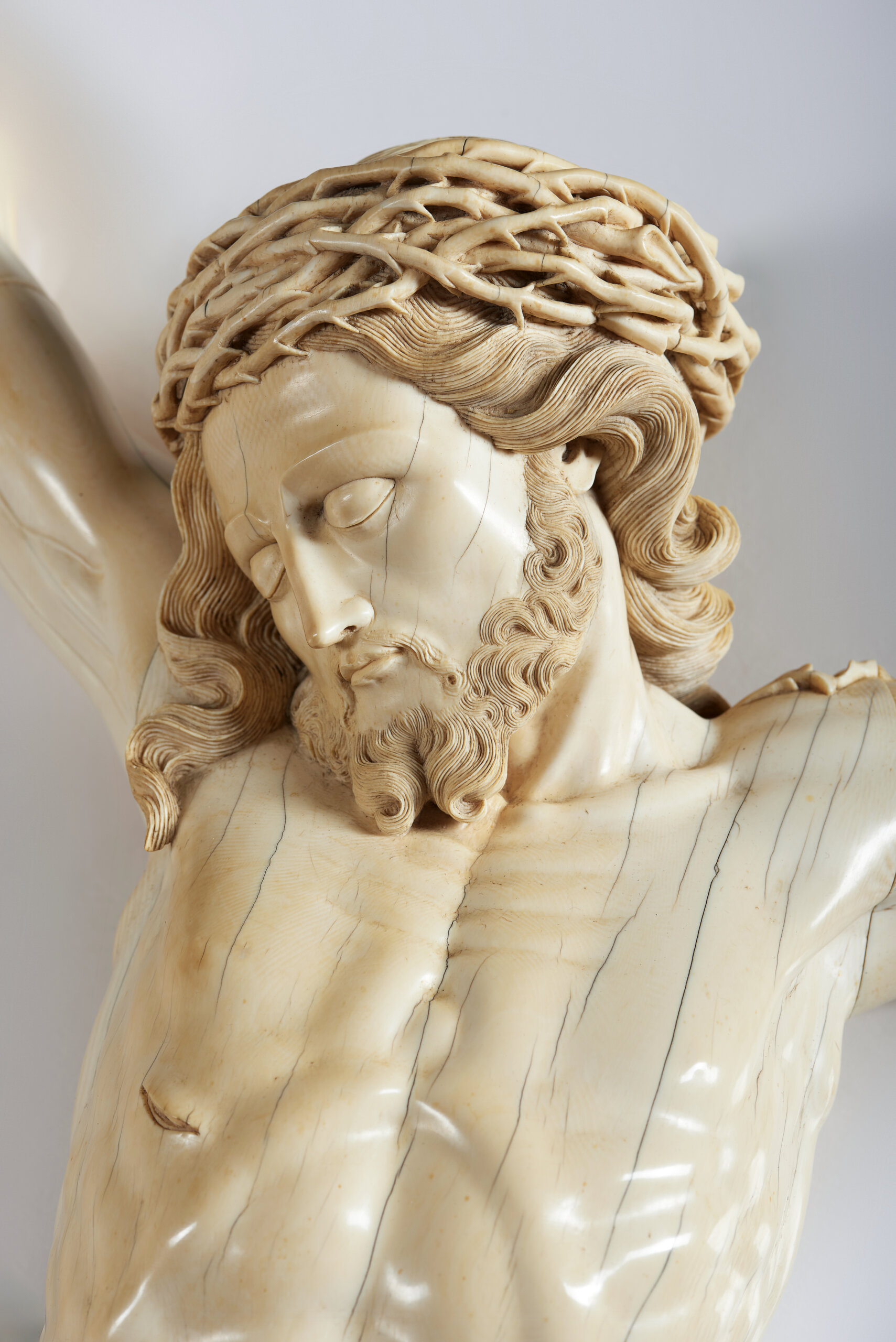
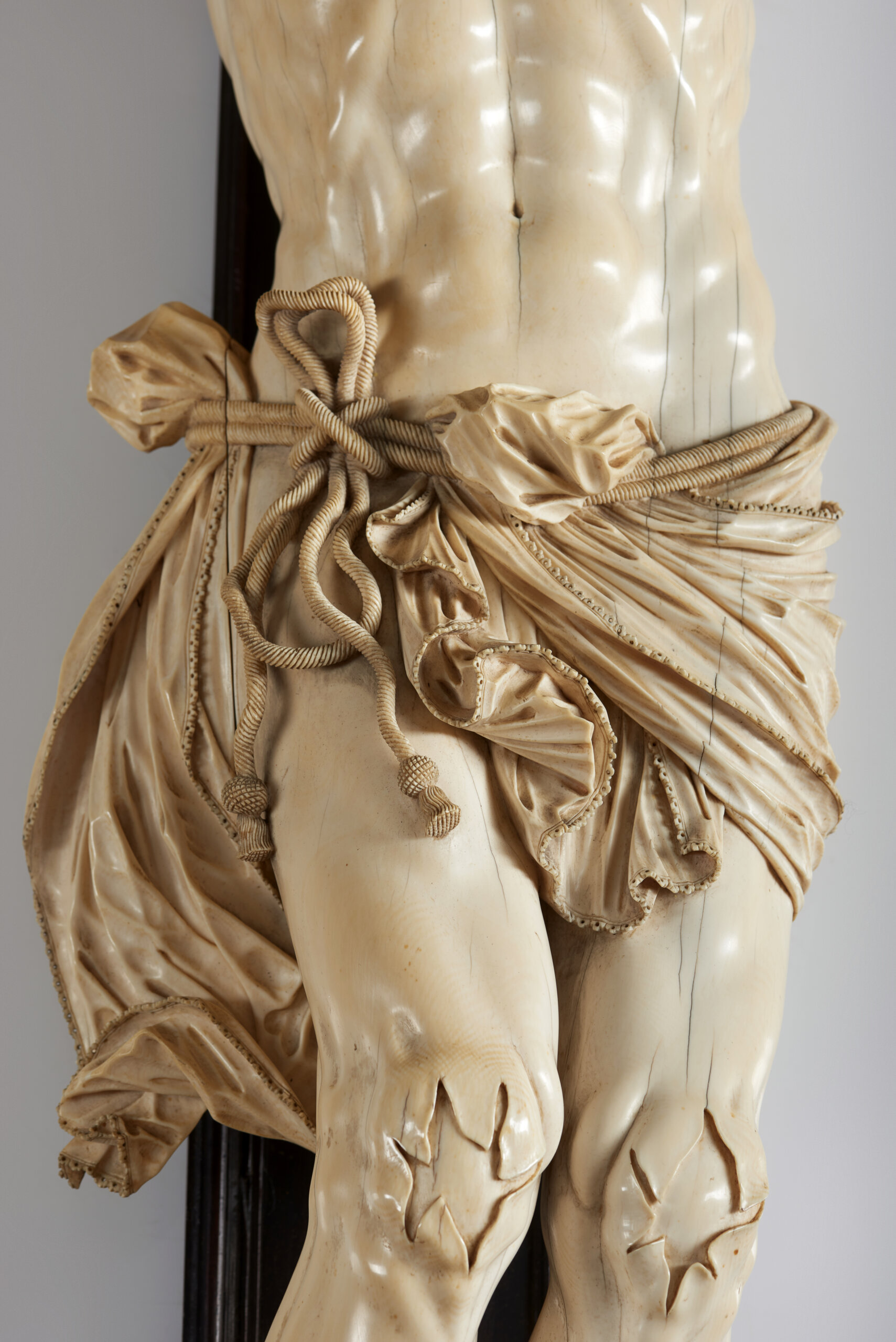
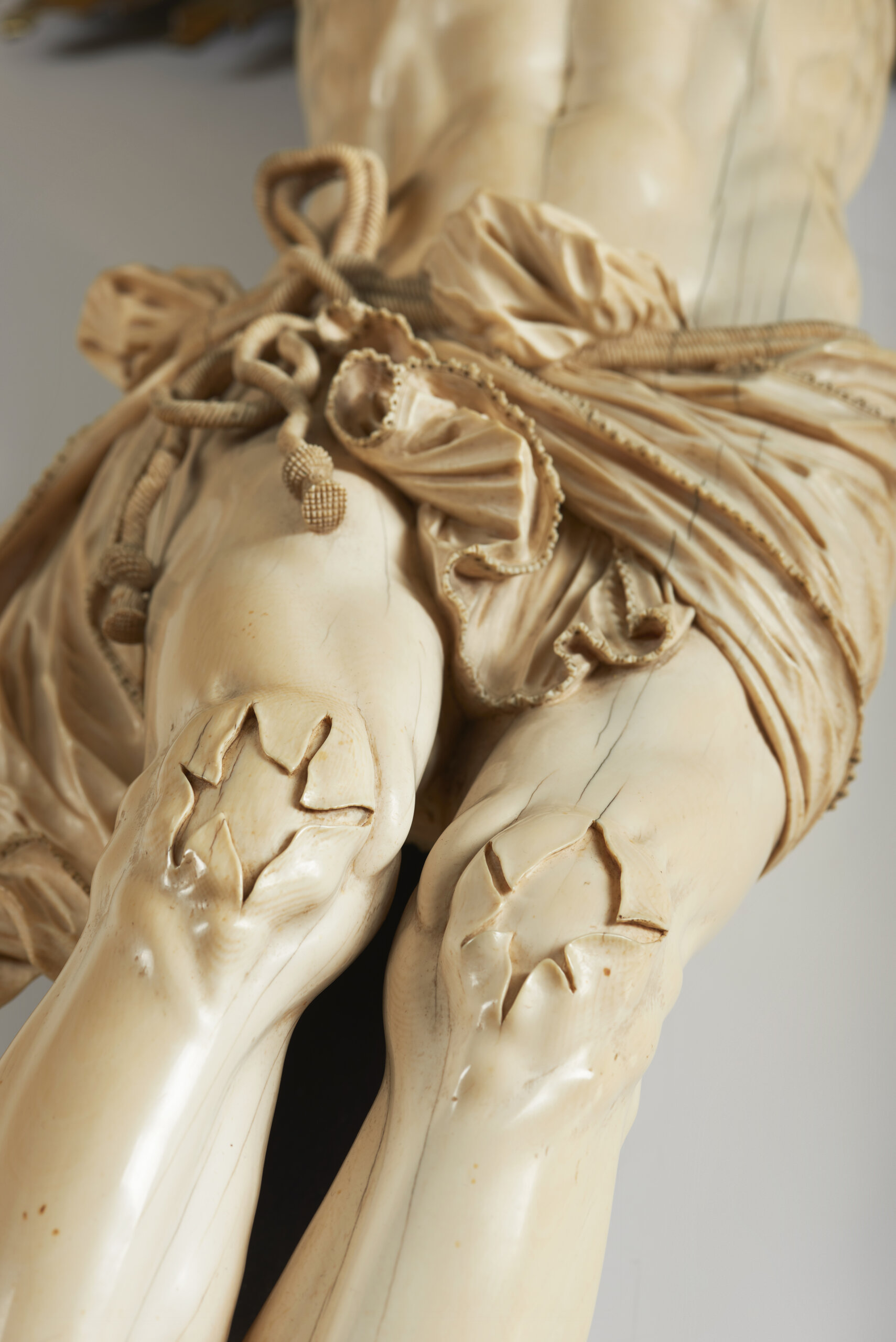
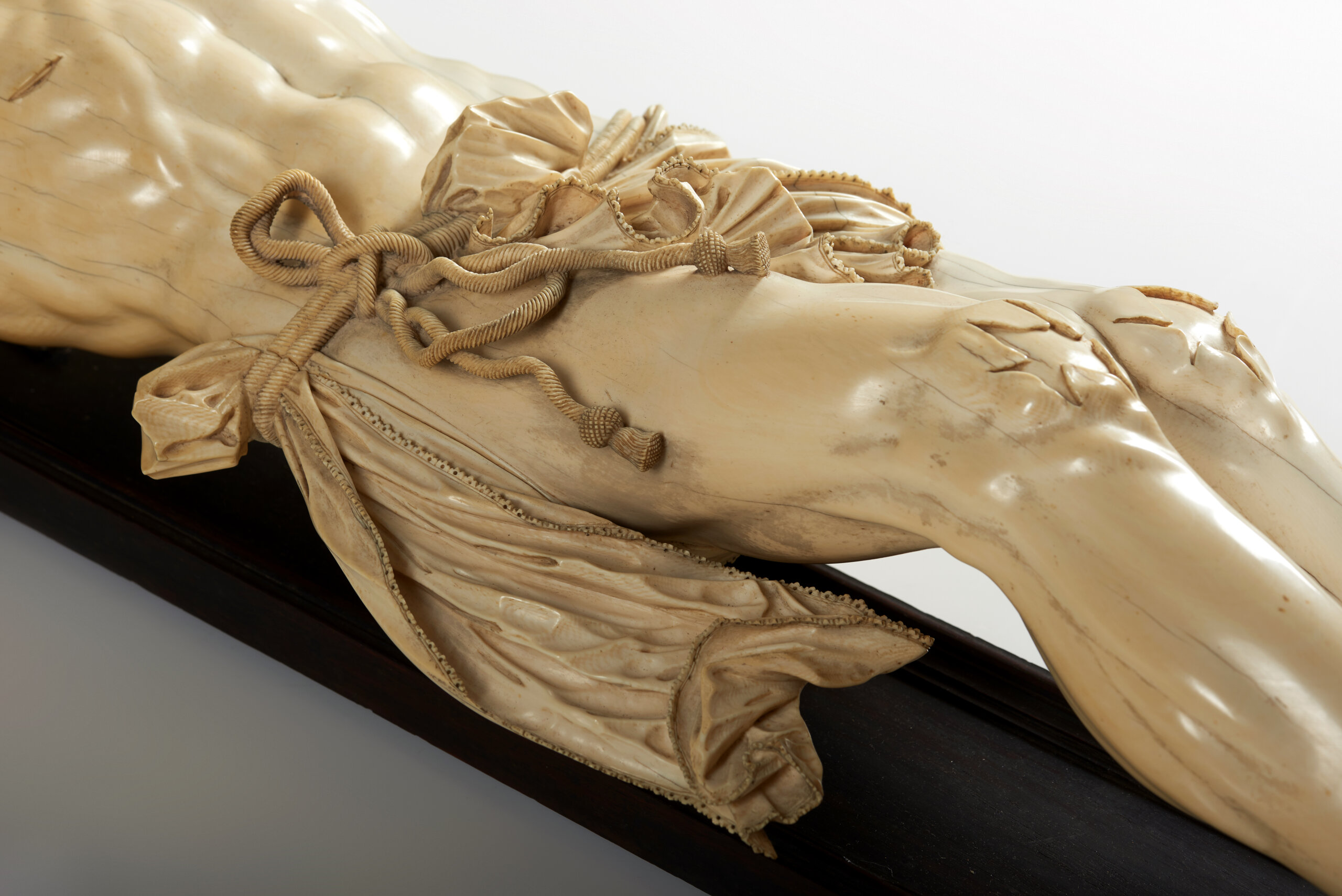
Deemed a precious material since antiquity, ivory carving in Europe, after a decline in the fifteenth and sixteenth centuries, rose to a new level of virtuosity in the seventeenth and eighteenth centuries, bolstered by a revival of trade and the growing availability of large, high-quality African ivory (see Schmidt, Sframeli 2013). Carved from elephant ivory, this monumental sculpture of the Crucified Christ was made in sections. The larger piece, following the natural curvature of the tusk, comprises the body of Christ—the head with its integral crown of thorns, the legs, and the feet. The outstretched, angled arms were carved separately and attached to the body using traditional wood-joining techniques, specifically the mortise-and-tenon joint. The protruding section of the loincloth on the left was joined in the same manner. Carefully rendering Christ’s bone structure, musculature, and veins, the master carver produced a beautifully articulated body at the exact moment of death. Christ’s head tilts to his right, falling forward to the chest and resting on his shoulder, his eyelids and mouth firmly closed. The fingers, still partially clenched, convey the last moments of pain before death’s release. The loincloth, tied on the right side and crumpled into deep, abundant folds, winds around a heavy, looped and knotted rope with hanging tassels, its lace hem delicately carved and pierced. Although serene in expression, Christ’s features are sharply defined: the shaven brows, the long nose, the beard carved in delicate curls, the hair rendered as near-individual strands. The stylised crown of thorns and the looped rope both display virtuoso undercutting, testifying to the carver’s superior skill. The large, unusual star-shaped wounds on the knees and the pronounced veins along the arms are also heavily stylised.
Although representing the Dead Christ, the sculpture merges two iconographical types devised in the mid-seventeenth century by the great Italian High Baroque sculptor Alessandro Algardi (1598-1654). From Algardi’s Cristo Vivo or ‘Living Christ’—the ‘Pallavicini’ type, created in the early 1640s—our piece borrows the angled outstretched arms, the clenched fingers, and the right foot nailed over the left (a highly unusual feature at this date), and the billowing loincloth bound by a sinuous rope. From Algardi’s Cristo Morto (the ‘Alamandini’ type), the carver adopted only the tilt of the head with its crown of thorns and the open chest wound. Both types were quickly disseminated throughout Europe, in models and prints alike, but the Cristo Vivo became the most popular Baroque crucifix, inspiring versions in a wide variety of media (see Mazzarelli 2013). The anatomical precision of our ivory—especially in the ribcage, the subtle modelling of the nipples, the undercutting of the crown of thorns, and the looped rope—though derived from Algardi’s prototypes, also recalls the work of the French ivory carver Claude Beissonat. Likely born in Franche-Conté, Beissonat lived in Spain around 1664 before settling in Naples, then under Spanish rule, where he signed several ivory carvings (see Estella Marcos 2011). Many of his signed works survive in Spain, including two Crucifixes that display striking affinities with the present sculpture. The closest parallel is the Cristo Vivo in the Real Academia de Bellas Artes de San Fernando, Madrid, an imposing work 86.0 cm in height including its ebony base and cross (see Estella Marcos 1984, vol. 2, p. 71, cat. 104). Though not by Beissonat himself, the present Crucifix was made in eighteenth-century Italy, possibly in Naples, by an artist clearly influenced by his style.
The greater stylisation of certain anatomical elements, such as the veins and the star-shaped wounds, together with the decorative flourish of wavy hair, suggests a date in the eighteenth century. A close analysis of the cross further supports this dating. Carved from ebony with simple mouldings, it bears gilt silver fittings: terminals at the three arms, a four-part sunburst at their intersection, and a radiant square halo above Christ’s head. The halo is chased with a simple petal frieze, while the pierced openwork terminals are polylobate and lavishly decorated with shell-like palmettes, sprays of tulips and other stylised flowers, and narrow acanthus leaves. The curled C-shaped motifs, employed alongside the floral idiom typical of early eighteenth-century Europe—especially France under the Régence (1715-1723)—contrast with the incipient rocaille ornament (c. 1710-1760) of the titulum crucis. The silver fittings’ motifs and workmanship point again to a Neapolitan origin, reinforcing the attribution of both cross and ivory carving to the same milieu (see Catello, Catello 1973). A comparable, though much smaller example (26.5 cm high) in the Victoria and Albert Museum, London (inv. A.20-1949), retains much of its original polychromy and gilding but has been wrongly identified as Goan in recent years (see Trusted 2013, p. 379, cat. 375). As with the present work, Christ bends its head to the right shoulder, eyes closed, with the right foot nailed over the left. Not only is the pose identical, but the treatment of the rope, the swirling loincloth, and the protruding shows striking affinities. Large-scale devotional ivories produced around 1700 have recently met with marked enthusiasm in the art market. In 2024, the Louvre acquired at auction a major ivory (54.5 cm high) of the Virgin of the Immaculate Conception (inv. RFML.OA.2024.9.1), carved in Naples by Claude Beissonat. The present monumental Crucifix is likely to elicit similar interest. Unfortunately, as is so often the case with masterworks in ivory left unsigned, the name of the carver of this extraordinary Crucifix remains unknown; yet the work itself proclaims his extraordinary artistry.
Hugo Miguel Crespo
Centre for History, University of Lisbon
Literature:
Elio Catello, Corrado Catello, Argenti Napoletani dal XVI al XIX secolo, Napoli, Edizione d'arte Giannini, 1973; Margarita M. Estella Marcos, La escultura barroca de marfil en España. Escuelas europeas y coloniales, 2 vols., Madrid, Consejo Superior de Investigaciones Cientificas - Instituto Diego Velázquez, 1984; Margarita M. Estella Marcos, “Esculturas italianas de marfil en España de los siglos XVI al XVIII con nuevas noticias sobre Gualterio, Beissonat y Caffieri”, in Regine Marth, Marjorie Trusted (eds.), Sculpture Studies in Honour of Christian Theuerkauff, München, Hirmer Verlag, 2011, pp. 22-29; Carla Mazzarelli, “New documents for Algardi’s Alamandini ‘Crucifix’, ‘a beautiful and famous thing”, The Burlington Magazine 155 (2013), pp. 769-773; Eike D. Schmidt, Maria Sframeli (eds.), Diafane Passioni. Avori barocchi dalle corti europee (cat.), Firenze, Sillabe, 2013; Marjorie Trusted, Baroque & Later Ivories, London, Victoria & Albert Museum, 2013
Closed Auction
