
736
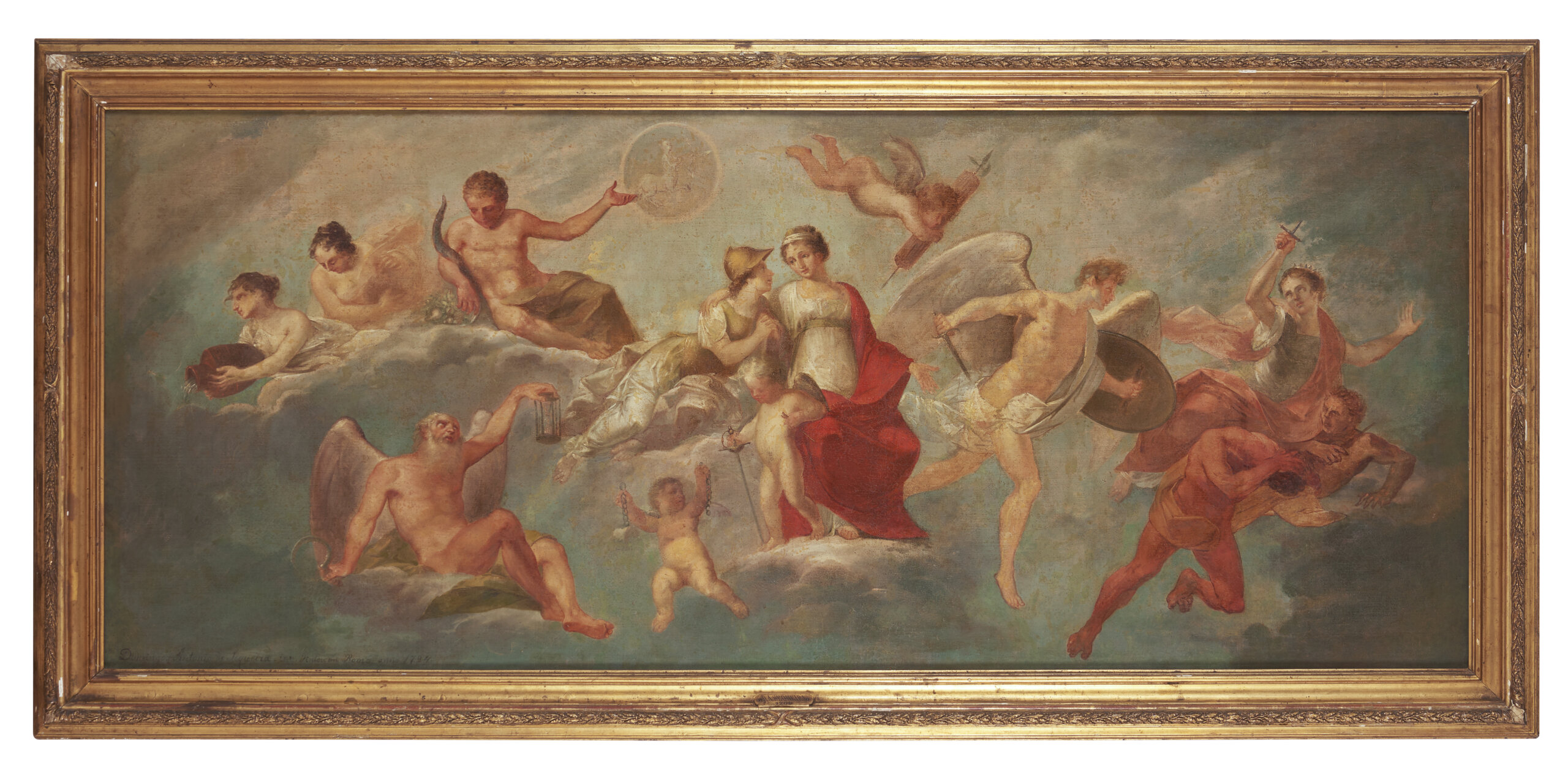
Allegory
Domingos Sequeira (1768-1837)
Estimate
95.000 - 120.000
Session 3
5 June 2025
Description
Oil on canvas
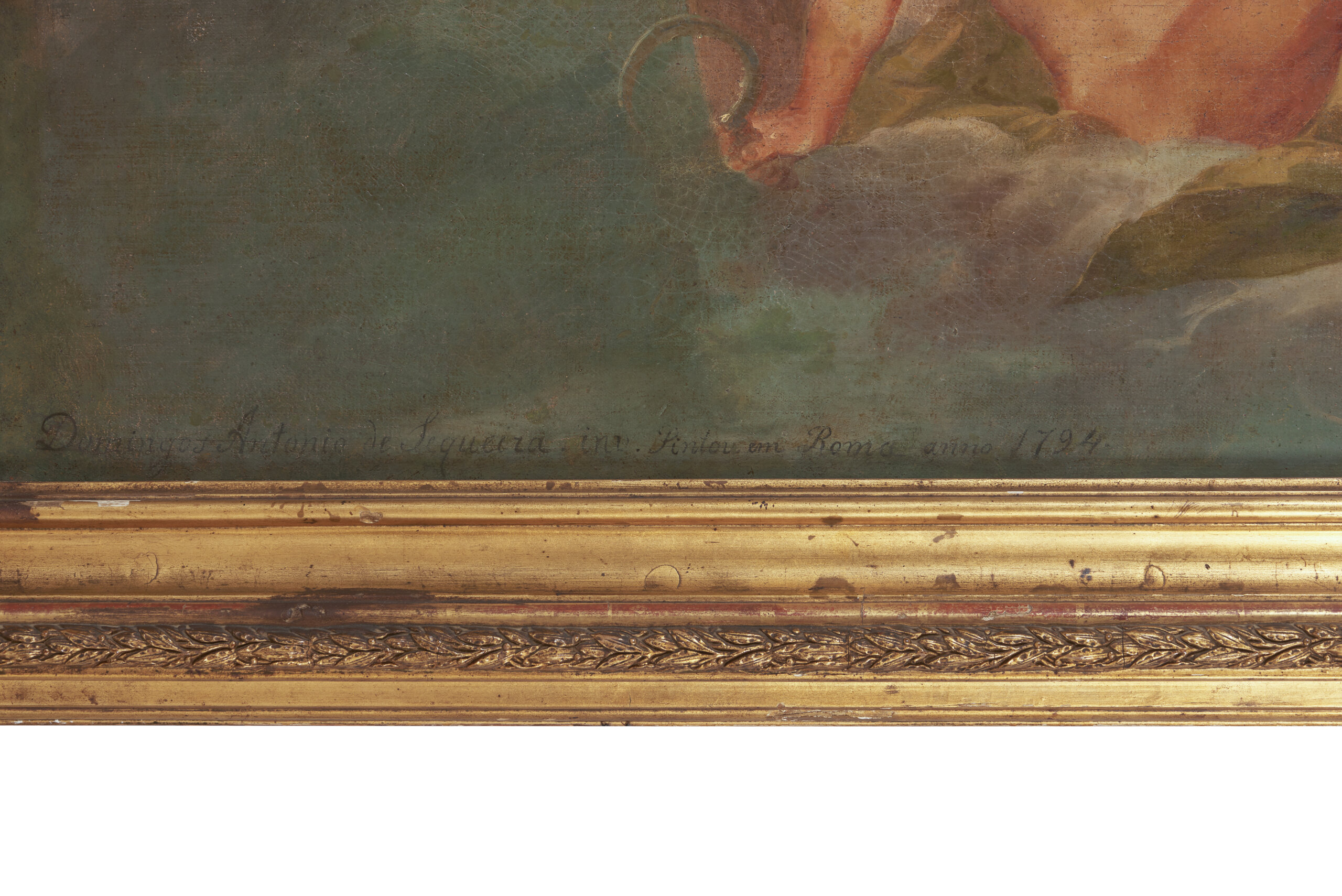
Inscribed “Domingos António de Sequeira inv. Pintou em Roma em 1794” lower left
100x237 cm
Category
Paintings
Additional Information
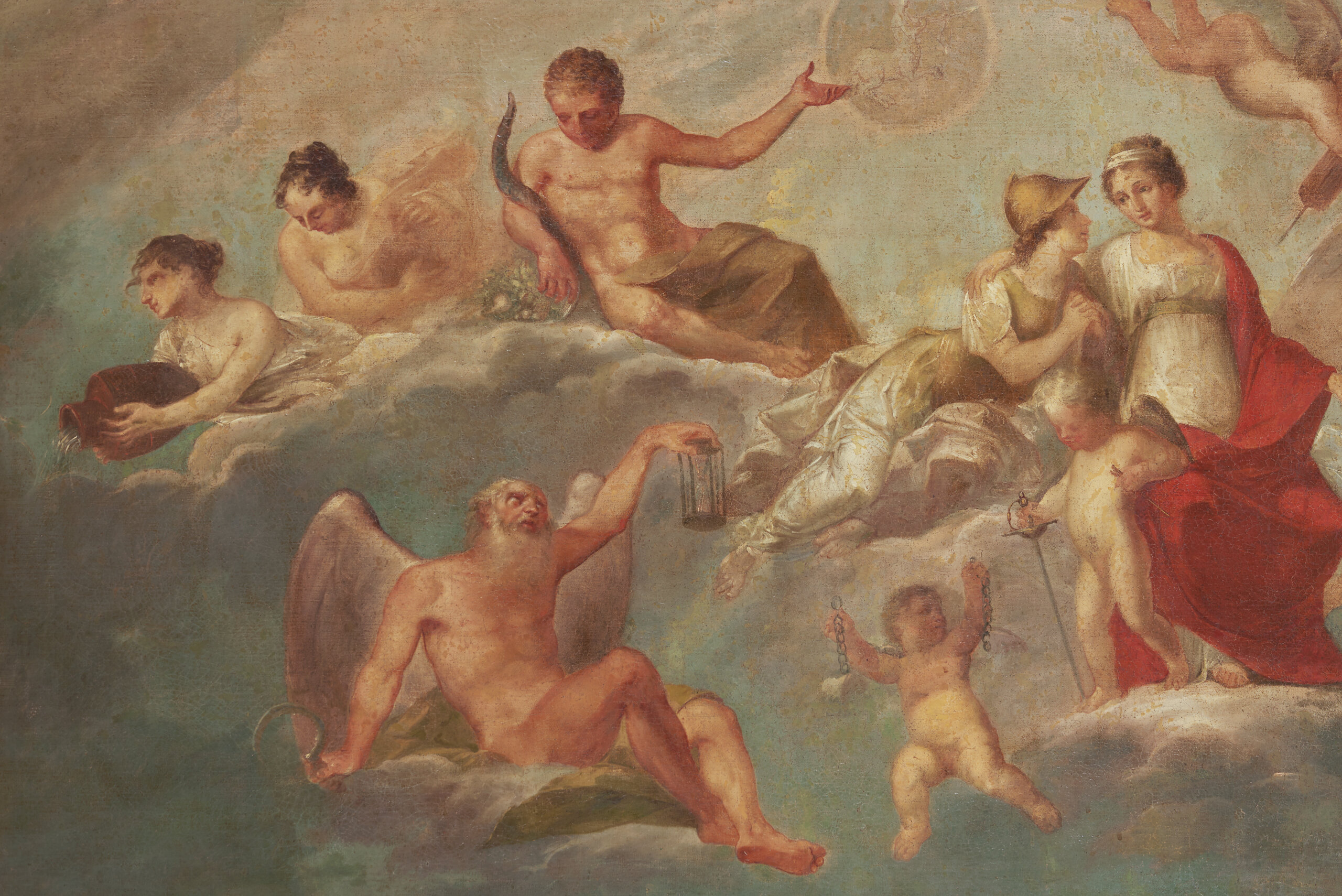
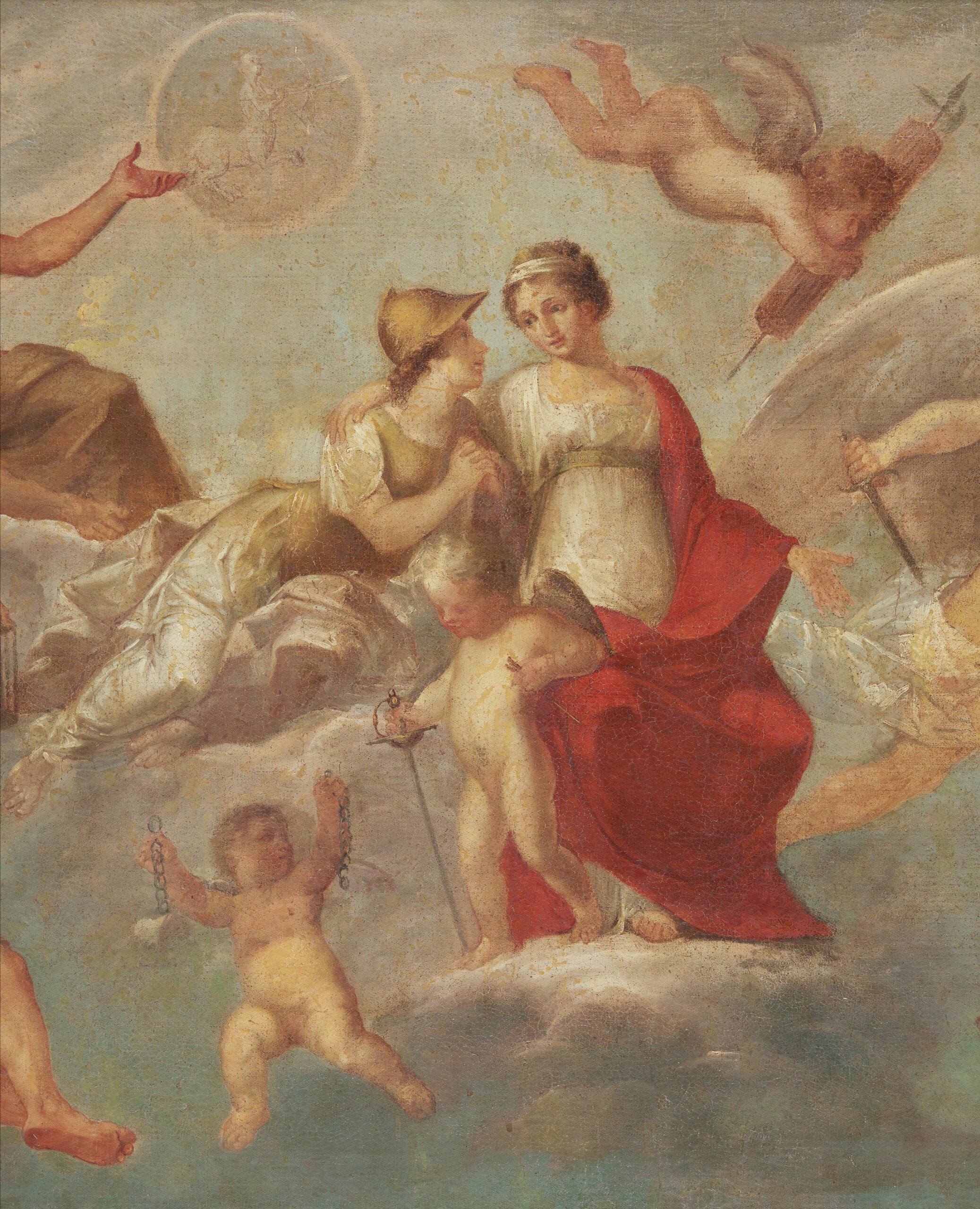
Allegory reproduced on the ceiling of the King John IV Hall at the Ajuda National Palace, Lisbon.
Identified in Diogo de Macedo’s book as “Allegory painted in Rome, in 1794” (translated from Portuguese).
Literature:
Macedo, Diogo de. "Domingos Sequeira", Realizações Artis, 1956, p. 101.
Catalogue Essay
TWO WORKS BY DOMINGOS SEQUEIRA:
Portrait of King João VI and Allegory
António FIlipe Pimentel
Art Historian
The presentation for sale of two works by Domingos António de Sequeira (Lisbon, 1768 - Rome, 1837) is always a matter of curiosity and interest, given the relevance of the painter and his complex biography, as well as the light they might bring to his own production. In the present case, both works are further united, beyond their authorship, by the personality of the prince who would reign from 1816 onwards as King João VI of Portugal (1767-1826).
Indeed, if in the first example the affinity seems obvious (being a depiction of the monarch himself), the second is also related to him, as decades after its execution (as confirmed by its inscription: Domingos António de Sequeira inv. Painted in Rome in 1794), it would serve as the basis for the ceiling of the “Sala de D. João IV” (King João IV Hall) in the Royal Palace of Ajuda, a central undertaking in the Lisbon intervention of his namesake descendant.
For the analysis of both pieces, therefore, it becomes necessary, in order to contextualise their production, to delve into the artist's life and the transformations of the Kingdom itself, particularly in the years between his first stay in the Eternal City and those preceding his definitive departure from Lisbon in 1823: in a political self-exile that would initially take him to Paris (where he would participate in the celebrated Salon of 1824, where the canvas “A Morte de Camões” would earn him a gold medal) and then to Rome, where he would achieve final recognition and the financial tranquillity that would allow him to create his masterpieces: the well-known (former) ‘Palmela series’ – and where he would die in 1837, prostrated by illness and unable to work in his final years.
Indeed, his training (after his stay in Lisbon with Joaquim Manuel da Rocha, between 1781 and 86, at the “Aula Régia de Desnho e Figura” – or "Aula do Rocha" – having also worked briefly with the painter-decorator Francisco de Setúbal) would take place essentially in Rome, where he remained from 1788 to 1795 as a pensioner of the Queen, under the protection of her ‘Royal Jewels Custodian’, João António Pinto da Silva, as well as successive ministers accredited there.
The Eternal City, in effect, would be during those years and until the French entrance in 1805, the undisputed European artistic centre, in an environment marked by internationalism (of artists, grand tour participants, or fugitives from the Revolution that had afflicted France since 1789), aesthetically shaped by a classicising eclecticism that Sequeira would absorb under the influence of his masters, Nicola la Picolla and António Cavallucci (then a famous painter and competitor of Pompeo Battoni and Raphael Mengs), as well as the Academy itself, which he subsequently attended (dominated by Domenico Corvi, himself a follower of Mengs and Carracci). Beyond formal resources, the artist would become imbued during these years with a particular taste for the complexity of allegorical discourse that would mark his future production.
Meanwhile, he achieved prizes in various competitions (beginning in 1789 with a 2nd prize in nude drawing, soon followed by another in invented composition drawing in the important Clementine Competition), while from 1793 he would be admitted (unanimously) as an academic of merit to the Academy of Saint Luke, an event that would obviously consolidate his position in the pictorial environment of the city. It is precisely from these years (between 1792 and 94) that the ambitious composition “Allegory of the Institution of Casa Pia” dates, a personal commission from the powerful Intendant Pina Manique, who appears portrayed full-length within an intricate rhetorical discourse, where a late-baroque reverberation still hovers beneath the garb of eclectic classicism, favoured by the complex discourse of allegories.
It is in this context and during the same years (1794) that Sequeira painted (for a purpose that remains completely unknown) the Allegory that now concerns us: perhaps we should not discard the possibility that it was a study made for one of the two ceilings which, according to information transmitted by Cyrillo Wolkmar Machado, he created at that time in the residence of the Cometti family, protectors of Portuguese (and, apparently, relatives of the painter’s beloved.)
Whatever the case, by then Sequeira would nurture an uncontrollable desire to return to Lisbon, where he would already be by late 1795, equipped with the tools that guaranteed him his Roman training and the reputation obtained there: the diploma of academic of Saint Luke (if not also those of associate of Bologna and Florence), the fame of the prizes obtained or the students he had prepared for competition, everything, in his understanding, combining towards a triumphant return! And the expectations, initially, would not be disappointed: as Cyrillo states, "everyone wants to have some work by the new artist", to whom, meanwhile, the Prince Regent had assigned an annual pension of 60 coins, plus paid accommodation, with freedom to accept any other commissions – adding, however, the memorialist: "but they were amazed at the prices he demanded".
Indeed, when, parallel to his warm reception, the artist proposed to lead the process of promoting the development of the arts in the country – emulating the academic system of Rome and, particularly, raising the scale of remuneration earned by artists to European levels – he would face the actual national reality, translated into his isolation in the respective class and the total incomprehension on the part of a clientele itself culturally isolated and financially impoverished. Frustrated and depressed, he then made a radical life decision: he entered, as a novice, the ‘Cartuxa de Laveiras’ in late 1798, from where he would emerge only in late 1800 or early 1801 – reportedly through direct intervention of the Prince Regent, who, in fact, immediately in the following year promoted his appointment (alongside Vieira Portuense) as ‘First Painter to the Royal Chamber and Court’, with a salary of two ‘contos de réis’ and their own carriage, both charged with directing the painting works of the new Palace of Ajuda, which had begun to be built. Also in that year of 1802, the first gold pieces (and bronze coins) bearing the effigy of King João, according to a model conceived by Sequeira, would be minted at the Casa da Moeda – a fact that will be relevant to our subject.
In the period that followed, besides some involvement in the Ajuda undertaking (especially in the accreditation of painters), he occupied himself with the creation of works of a historical nature, while making sketches for wall decorations in the Royal Palace-Convent of Mafra, partially realised – but by others.
In the interim, he accumulated honours and prebends: in 1803 he would be appointed painting master to the Princess of Beira, Maria Teresa, as well as to her aunts, Maria Ana and Maria Francisca Benedita, in addition to her mother, the Princess of Brazil, Carlota Joaquina; in 1805 he would be awarded the habit of the Military Order of Christ; finally, in 1806, he would succeed Vieira Portuense, who had died the previous year, as director and lecturer of the “Aula de Debuxo e Desenho” attached to the Royal Academy of Maritime and Commercial Affairs in the city of Porto.
And, precisely, it was in Porto that he found himself, enthusiastically devoted to his new mission, when, in November 1807, the 1st French invasion took place, forcing the Court's departure to Brazil. In January 1808, however, already in Lisbon, Sequeira began a close relationship with the invader, particularly with Junot, who would preserve him in the direction of Ajuda and for whose service he would elaborate some compositions that would soon cause him troubles.
Indeed, once the invasion was overcome, through the aid of the British troops commanded by the future Duke of Wellington, Sequeira would be imprisoned in December of that year on charges of collaborationism, spending the following nine months in Limoeiro prison. Released in September 1809, he would retain the position of Painter to the Royal Chamber and Court, although he would not return to exercise the functions of director of the painting works at Ajuda, nor execute any works for the building.
Upon returning to his activity at the Porto Academy, he strove, henceforth, to erase the bad image generated by his Francophile production, creating a set of notable compositions (always of allegorical nature), dedicated to the English general or commemorating the return of the royal family in 1810 – the year in which he also began studies for his ambitious composition “A Sopa de Arroios”, published as an engraving in late 1813.
Since 1811, however, Sequeira had been grappling with a truly extraordinary commission: a monumental silver service that the Portuguese Government had decided to offer to Wellington in recognition of his invaluable service in the definitive liberation of the Kingdom, after the 3rd French invasion of the national territory was repelled in April of that year. To this operation, of enormous technical and logistical complexity (involving a team of almost one hundred and fifty technicians of various specialties), he would dedicate himself, body and soul, in the years that followed, from 1812, 13, 14, 15, and 16, when, finally completed, the immense silver service – composed of 758 pieces, to which was added the monumental centrepiece, 8 meters in length and designed for the service of more than 60 diners – would be shipped in mid-September to London.
During these years, in truth, Sequeira would only have abandoned the great enterprise to attend to the obligations of his teaching, or already in 1815, when he designed and directed the execution of a set of gold-chiselled pieces destined for Marshal Beresford – and the portrait of King João VI that concerns us should date from the following year (1817), which Alexandra Markl likens to another, quite identical one, created by the artist for the Royal Academy of Maritime and Commercial Affairs, traditionally dated to (around) 1807, designating it, accordingly, as Portrait of the Prince Regent.
Indeed, it is not only the inscription (JOANES VI), on the sheets upon which the monarch rests his left arm (which, in the Porto example, display the plans for the new Academy headquarters), that, by nature, precludes an execution prior to 1816, the date when the Prince Regent finally assumed the title of King: also the honorary insignia themselves dissuade – namely the plaque of the Royal Military Order of the Tower and Sword, which the sovereign displays, on the blue coat, on the left side of his chest, next to the insignia of the Order of Charles III of Spain. Indeed, if the latter in no way contributes to what concerns us (King João had been a ‘Gran Cruz’ since 1796), the same does not apply to the former, since it was a new creation, which would take place in Brazil in 1808 (although only announced in 1809: the period when the artist was imprisoned). And it happens that, in 1810, a new reform would occur, replacing, in the central medallion, the effigy of the Regent (traced from what Sequeira had conceived in 1802 for the new monetary species), with a medallion depicting the sword of the Order, crossing a laurel crown, while, superimposed on the star, the tower is visible.
Now, it is this latter version that is represented, with the artist refraining from alluding to the one that includes his own creation of the royal effigy – which seems, indeed, to extend in time the execution of the painting, bringing it closer to implausible years of work, such as those from 1811 to 1816, absorbed in the obsessive enterprise of the silver service. With this we arrive at 1817 as the most probable date for the creation of this painting (as well as, naturally, its Porto twin), in agreement with the original legend that identifies it as JOANES VI.
In truth, moreover, the artist would lack an updated model of the monarch, who had been absent in Brazil for a decade, so the physiognomy, necessarily stereotyped, reflects the features and characteristics (such as the short, white-powdered hair) that he had been able to observe in the early years of the century, and would leave captured in the Ajuda portrait (1802) or even, in 1810, in the “Allegory of the Virtues of the Prince Regent”.
Of reasonable dimensions (124 x 96 cm), the painting depicts the monarch seated, wearing a blue coat with gold braid and yellow breeches, turned to the left of the composition, his right hand resting on a lictor's fasces, around which an ivy entwines, while his left arm, as mentioned, rests on a pair of sheets of paper (on one of which the identifying legend is visible), placed on a table whose visible side, of architectural flavour, still refers to the Louis XVI taste: while he directly gazes at the observer, with his strangely youthful face, cut against the red drapery of the curtain, which, in the good tradition of court portraiture, opens onto a fantasy architecture and, in turn, to an equally imagined horizon...
An effective conception, in its updating of codified visual resources, the impossibility of resorting to elementarily updated iconographic sources would make it hostage to the scheme idealised by Domenico Pellegrini in the more ambitious composition of his ‘Portrait of the Prince Regent João’, created in 1805 and currently preserved in the Portuguese Consulate in Rio de Janeiro: identical setting (curtain and fantasy architecture – but grandiose, by virtue of the amplitude of the canvas, much more generous than what Sequeira would use – opening onto a city where a somewhat idealised Lisbon is evoked); identical position and location of the portrayed (this time represented full-length, red coat and yellow breeches, white stockings and shoes), illustrated here with urban building plans, facing a statue of Minerva, which, in the vast horizontal canvas, serves as a counterpoint. Above all, however, what stands out is the same global depiction of the future sovereign that Sequeira would come to use (by force of circumstances) and standardise in his compositions.
In truth, as Alexandra Markl notes, the absence of any iconographic element in "our" King João VI prevents us from having any notion of the location for which it was intended. However, one last similarity occurs between both paintings, further reinforcing the notion of a relatively late execution of Sequeira's work: the similarity of the insignia of the Tower and Sword in both compositions – knowing today, however, that in Pellegrini's painting it is a later addition, intended to conceal the originally represented insignia, since converted into a political embarrassment: the plaque of the Legion of Honour, granted, precisely in April 1805, by the Emperor of the French, Napoleon I.
The period that follows, meanwhile, would bring novelties to the complex process of building the new royal residence, essentially arising from the appointment, in January 1818, of Joaquim da Costa e Silva as inspector of the Royal Works of Ajuda. Determined to give a new impetus to the works, he summons Sequeira for a series of Conferences, intended to reorganise the painting works – in a movement that would have repercussions in 1820, when, on August 4, a royal decree, signed in Rio de Janeiro, determines "the direct intervention of the Inspector of the Work and the artists Domingos Sequeira, Cyrillo Wolkmar Machado, and Manuel Piolti in the subjects of the paintings and their respective direction".
Sequeira would come to take advantage of the successive Conferences to associate with the undertaking the painters Arcângelo Fuschini and José da Cunha Taborda, with both of whom he had shared his years in Rome – and with this new phase of his intervention the present Allegory is related.
Indeed, in the Conference held on January 10, 1822, it would be established that the great hall which, on the eastern façade, served as a vestibule to the “Sala dos Archeiros” (later “Sala dos Embaixadores”), to whose southern flank it is attached, should be adorned with "an Allegorical Painting to the Acclamation of King João IV", to be executed by the "Painter José da Cunha Taborda with the cooperation of his Colleagues". In fact, since 1819 the monarch himself had insisted on this theme, according to the list of Subjects for the Paintings of the Work of the Royal Palace of Ajuda, dispatched from Rio de Janeiro on November 15 of that year and which Fuschini would reveal on the same occasion.
Meanwhile, still in 1819, but in January, in a list of thematic recommendations for the ornamentation of the rooms of the royal building, it was proposed, as a subject for the respective ceiling, “A Clemência de Tito excedida” – and it is known that Taborda would come to elaborate, with this aim, a watercoloured drawing, which is preserved (MNAA). However, João VI's insistence on also associating the ceiling with the evocation of the Dynasty's founder would lead to the rejection of the project, due to the manifest absence of thematic relationship. And it is certainly then that the idea of using, as the central panel of the composition conceived for the vault by Taborda (who also executes, in its cornice, the representations of History, Poetry, Music, and the Tagus), the old canvas painted in Rome by Sequeira, in the now distant year of 1794, would have taken shape.
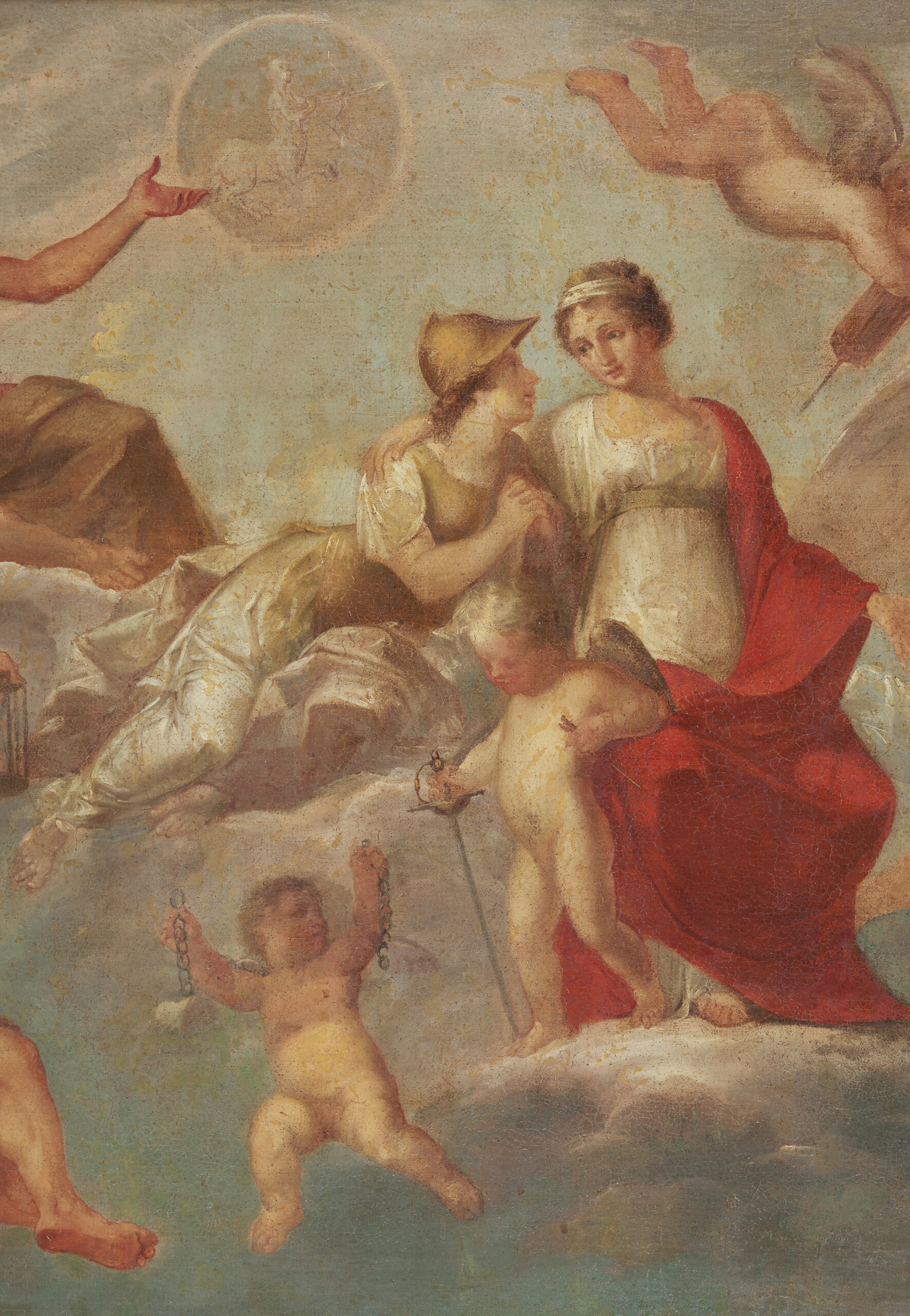
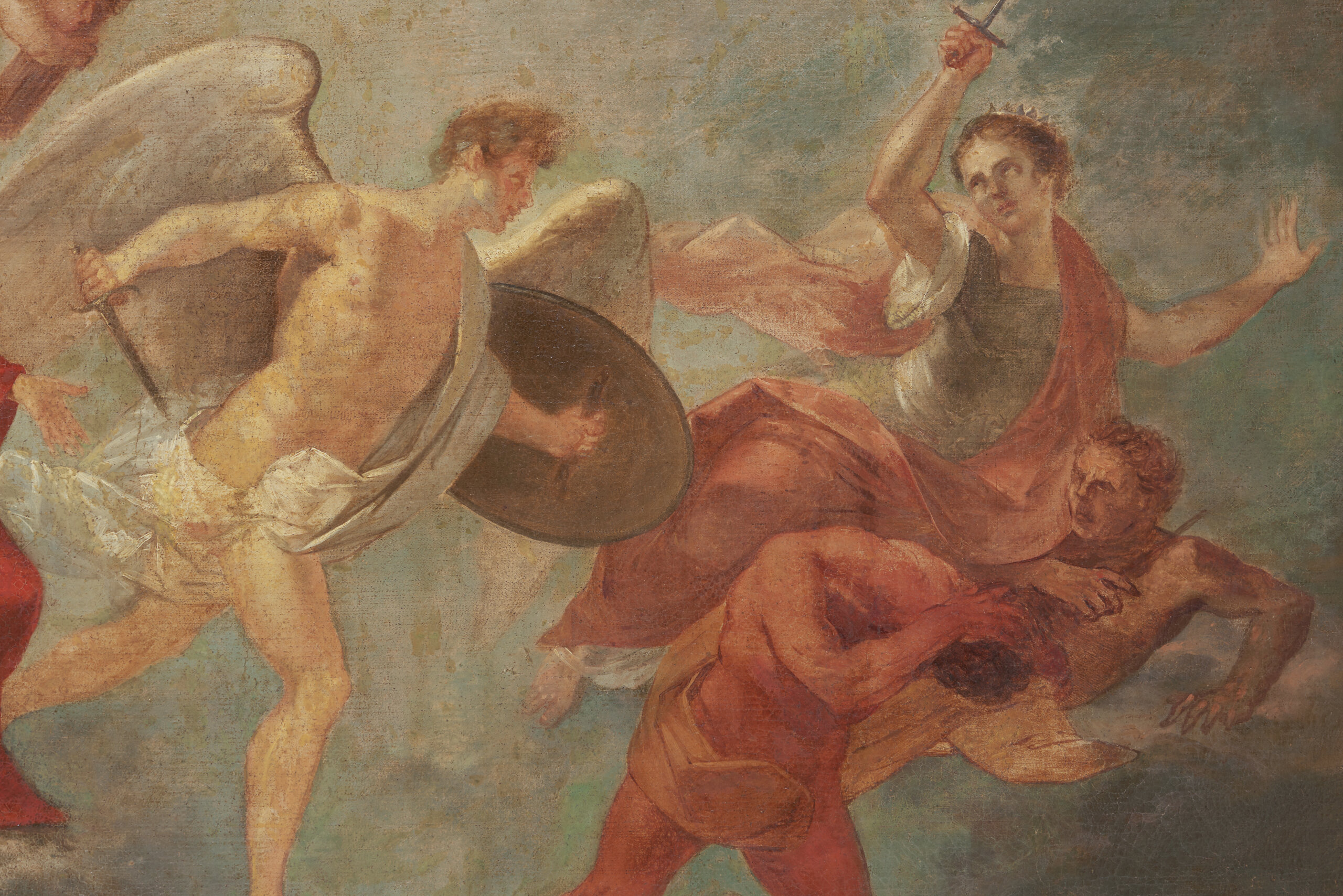
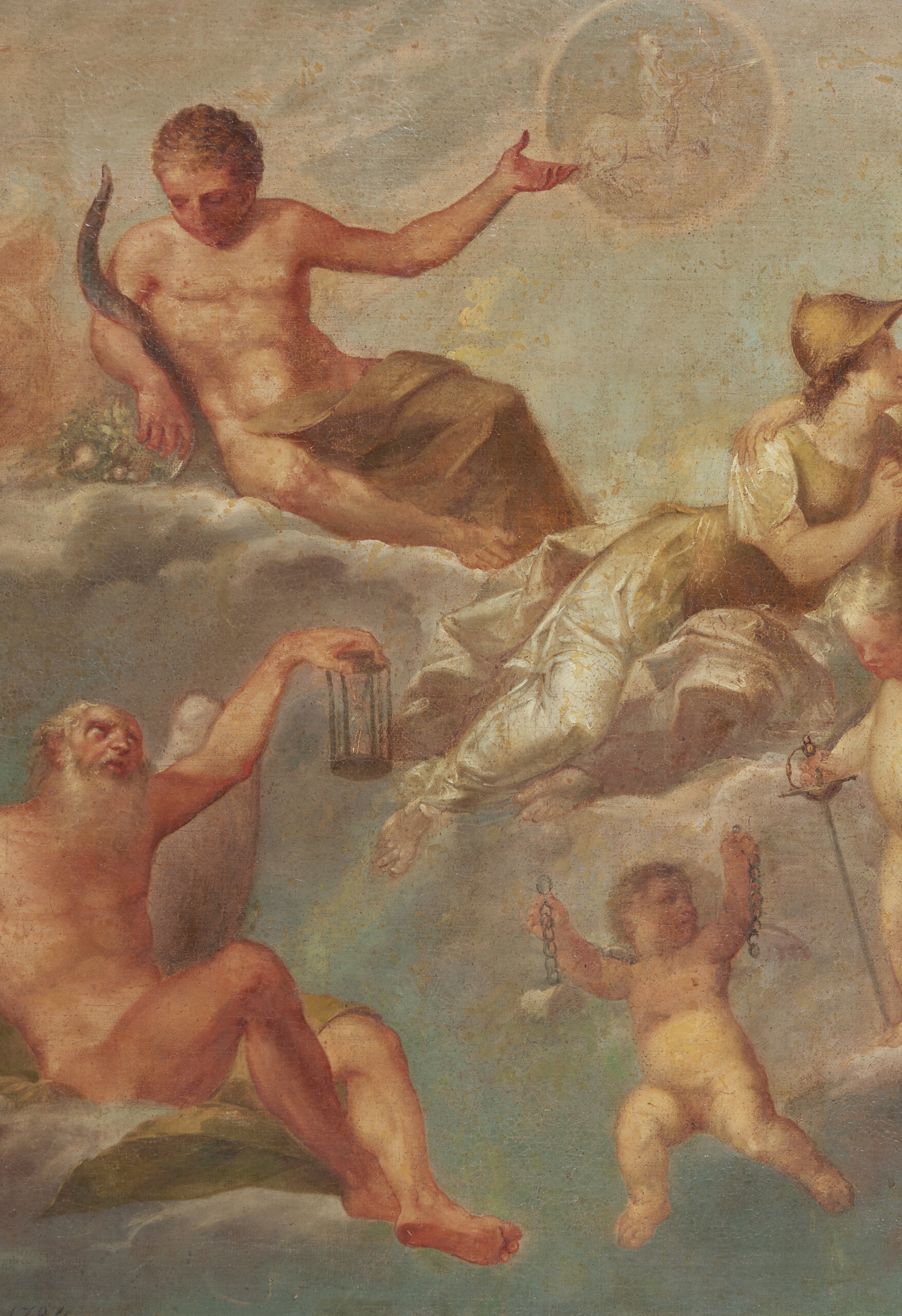
Indeed, this Allegory would fit like a glove to the commemorative context of the Restoration in the new King João IV Hall, under the epitome of ‘Allegory of Justice and Concord’. Thus, the artist would have represented, in the centre, embracing, Justice and Wisdom, whose attributes are carried by two putti and a third brandishes in his little hands a broken shackle. While, on the left flank of the composition, a figure of a winged elder personifies Time, on the right, a youth, likewise provided with wings, wielding a sword with his right hand and sustaining with his left arm a shield, precipitates upon a small group of malignant figures, who flee terrified. At the other extreme, over the figuration of Time, appear the symbols of abundance, carried by three characters: two female and one male, who indicates a disc where the zodiacal sign of Sagittarius is visible.
Indeed, a strange reason would make this Allegory especially pertinent in a space conceived as celebratory of the Portuguese triumph in the framework of the Restoration of national independence in 1640. Thus, therefore, from the putto who, in the central group (involving Justice and Wisdom) presents the broken shackle (of the former subjection), to the winged youth who, on the right side of the composition, chastises the enemies (and might well represent, after all, the Tutelary Genius of the Kingdom, expelling the oppressors), to the very group on the left (of more problematic identification), which could thoroughly illustrate the abundance and prosperity that would await the Nation once freedom was recovered – and even the enigmatic presence of the Zodiac, after all amply justified, in its reference to Sagittarius, by evoking events that occurred on December 1st! – everything seems, in fact, to combine in a perfect evocation of the founding event of the Braganza Dynasty.
It is certain that the allegorical composition would be faithfully transposed to the ceiling of the King João IV Hall of the Royal Palace of Ajuda, with its centre corresponding rigorously to the vast composition (100 x 237 cm) painted by Sequeira in Rome in 1794. But not by him, similar, in truth, to what had already occurred in Mafra. Indeed, Manuel Piolti would inform, in the ‘Descrição’ he elaborates on January 20, 1823, that the representation (which he calls Heroic Virtue), was due to the brush of Máximo Paulino dos Reis – a year that, in effect, corresponds to the creation of the vault painting, as well as the representation, by the same Taborda, of the acclamation of the Restorer King, according to a document where, in July, the frames of the respective overdoors are addressed: and thus also, obviously, of the central reserve, where Máximo Paulino had transposed Sequeira's Roman allegory.
And it could not be otherwise: in fact, since (at least) late 1820 – scant months after his new appointment to the superintendence of the Ajuda works – the artist had been engaged in frantic activity in the service of the Government and, in general, of everything that involved the liberal movement set in motion in Porto since August of that year and which, on October 1, had extended to Lisbon: whereby he could hardly reconcile this excessive effort with the placid painting of the ceiling of the royal dwelling. Moreover, on September 7 of that year of 1823, Sequeira would abandon the Kingdom forever, embarking towards Plymouth and a voluntary exile, with which he sought to avoid repeating the episodes of 1808, following the counter-revolutionary coup called the “Vilafrancada”, which occurred on May 27 previous. Exile that would lead him to Paris (and the Salon of 1824) and, afterwards, to Rome, where he would die in 1837, leaving incomplete the ‘Palmela series’, where he would make the final proof of his incontestable talent as a painter.
In fact, the Allegory would lose, in its transposition, the play of glazes present in Sequeira's canvas, in favour of a flat and strictly rhetorical painting. This, from the outset, is the central relevance of the great canvas, not only in the artist's work, where it allows us to scrutinise the paths followed in the years of his Roman formation, but equally with respect to the creative process followed in the royal site of Ajuda – for better or worse, the great national undertaking in the first quarter of the nascent century. And the same can be said of the Portrait of King João VI – once its chronology has been unravelled. Unable to compare, in its obvious stereotypy, with the great works of the painter's portraiture, it nevertheless attains a level of secure dignity in the necessarily abstract depiction of the absent King. And both contribute to adding new links in the complex chain of the notable artist's work.
Closed Auction
