
83
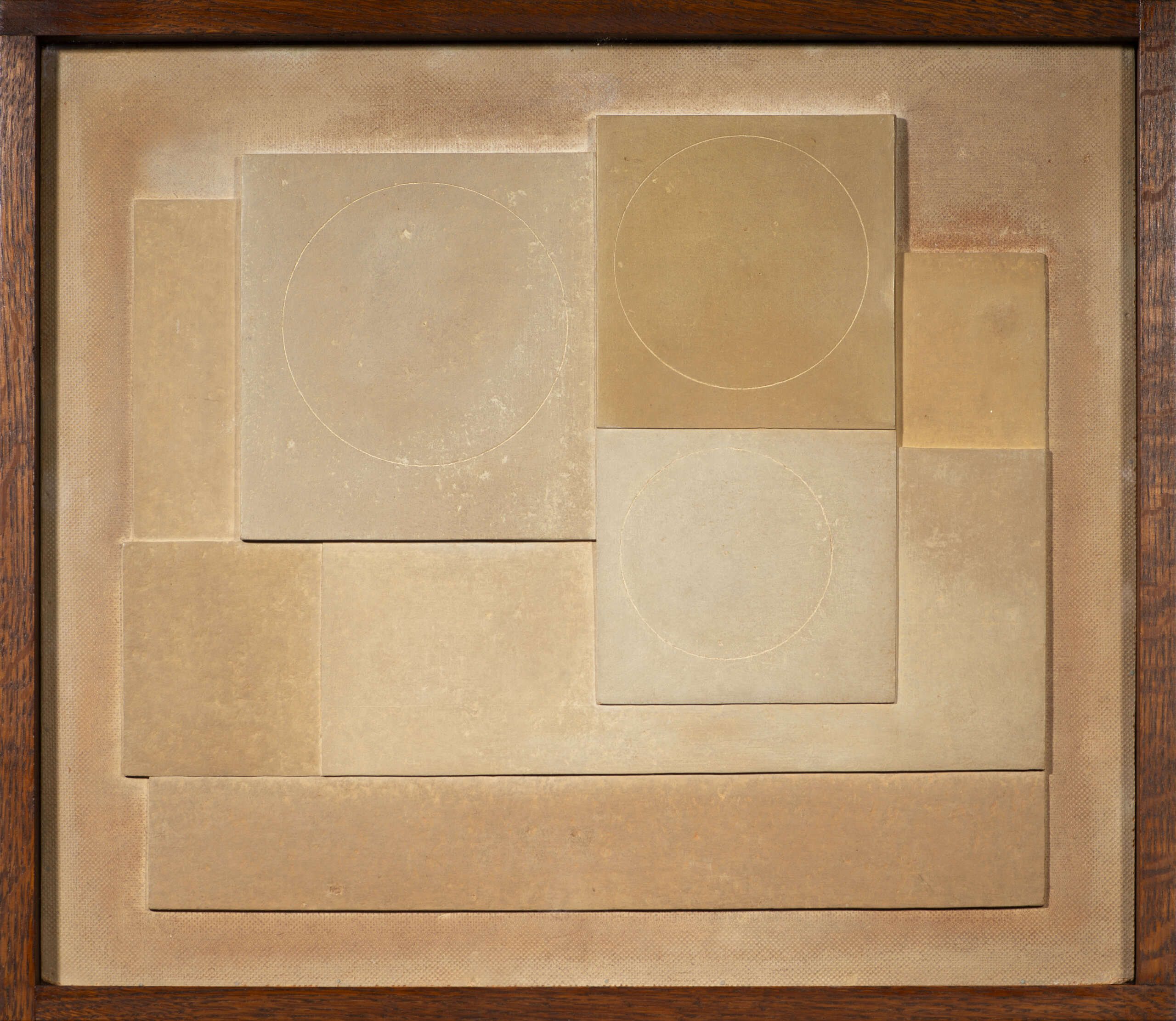
"3 Circles"
Ben Nicholson (1894-1982)
Estimate
150.000 - 200.000
Session
8 October 2026
Hammer Price
Register to access this information.Description
Painted relief
Hardboard, cardboard and plywood, carve, glued, painted and incised, mounted on a wooden stretcher
Signed and dated Jan 57 on the reverse
50,5x59x2 cm
Category
Modern and Contemporary Art Paintings
Additional Information
Bearing the André Emmerich Gallery stamp on the reverse.
Note about the lot
Ben Nicholson: The Poetry of the Surface
3 Circles, 1957
Some works make an immediate impact; others win you over slowly, the longer you look. 3 Circles belongs to the second kind. At first glance it is a quiet arrangement of rectangles in shades of sand, ochre and stone. Then raking light brings out the relief: the edges, the layers, the small shadows between the planes. Finally the circles appear, three hair-fine lines cut into the surface, almost like secrets.
Ben Nicholson (1894–1982) grew up surrounded by art. His father, Sir William Nicholson, was one of the most admired painters and illustrators of Edwardian England, and his mother, Mabel Pryde, was also a painter. From this background came a lifelong love of still life: jugs, glasses and tabletops that run through his entire career, even when figuration seems to have disappeared.
The turning point came in the early 1930s in Paris. Nicholson visited the studios of Picasso, Braque, Brancusi, Arp and, above all, Piet Mondrian, whose white, pared-back studio made a profound impression on him. In 1934 he made his first white reliefs, carving and cutting wood into rectangular and circular planes painted entirely white. They caused a stir in the British art world and are now seen as a founding moment of modern abstraction in Britain. Together with the sculptor Barbara Hepworth, whom he married, and Naum Gabo, he stood at the centre of the London avant-garde of the decade, whose manifesto was the publication Circle (1937).
In 1939, with war approaching, Nicholson and Hepworth moved to St Ives, a small fishing town in Cornwall. He lived there for almost twenty years, and the landscape entered his work for good: the Atlantic light, the granite walls, the whitewashed houses, the stone worn smooth by sea and wind. Nicholson's abstraction was never cold or purely geometric. It always breathed the real world.
The 1950s brought international recognition. Nicholson won the Carnegie Prize in 1952, was honoured at the Venice Biennale in 1954, received the first Guggenheim International Painting Prize in 1956 and, in 1957, the very year of this work, the Grand Prize for Painting at the São Paulo Bienal. It was also at this time that he returned in earnest to relief, now in a new language, warmer and more tactile. Shortly afterwards, in 1958, he left St Ives for Ticino in Switzerland, on the shores of Lake Maggiore.
3 Circles is signed and dated January 1957, at the height of this mature period. Nicholson built it by layering and gluing sheets of hardboard, cardboard and plywood, cut into rectangles of varying thickness and size. He then painted them in thin coats, scraped them, sanded them and painted them again, until the surfaces seemed found rather than made: limestone, old plaster, paper faded by the sun.
Look at the outer border, where the artist left the woven texture of the hardboard exposed. This is no accident. Nicholson liked to reveal the nature of his materials, and that mechanical grid sets up a delicate contrast with the hand-worked areas within.
The composition rises like a small piece of architecture. Planes advance and recede, lean on one another and fit together like stones in a dry-stone wall. The palette is deliberately restrained, with sands, rosy beiges, a pale grey and a single rectangle of golden ochre that acts as the source of warmth and light for the whole work.
And then there are the circles. Nicholson did not paint them; he drew them with a sharp point directly into the surface. There are three, and no two are alike: a large one inscribed in the grey plane on the left; another, crisp and luminous, on the ochre; and a third, almost vanishing, in the pale lower plane, revealed only to those who come close. The circle was an obsession throughout his career. It might recall the rim of a plate or the mouth of a glass, echoes of the old still lifes, but also a sun, a moon or simply the perfect form. Nicholson preferred not to choose. The strength of the work lies precisely in this balance between geometric rigour and poetic suggestion.
The painted reliefs are widely regarded as the most original and most sought-after body of Nicholson's work. No other artist of his generation made anything quite like them, poised between painting and sculpture. Reliefs from this period are held in collections such as Tate, the Museum of Modern Art in New York and the Kunstmuseum Basel.
3 Circles brings together everything that defines the artist at his best: economy of means, sensitivity to material, a composition of almost musical precision, and that silent quality which makes these works companions for a lifetime. The André Emmerich Gallery stamp on the reverse also links it to one of the most respected New York galleries championing twentieth-century abstract art.
It is a work that asks for time, and rewards it generously.
Closed Auction
