
93
Untitled
António Quadros (1933-1994)
Estimate
10.000 - 15.000
Session
8 October 2026
Hammer Price
Register to access this information.Description
Oil on wood
81,5x122 cm
106x146,5 cm (com moldura)
Category
Modern and Contemporary Art
Additional Information
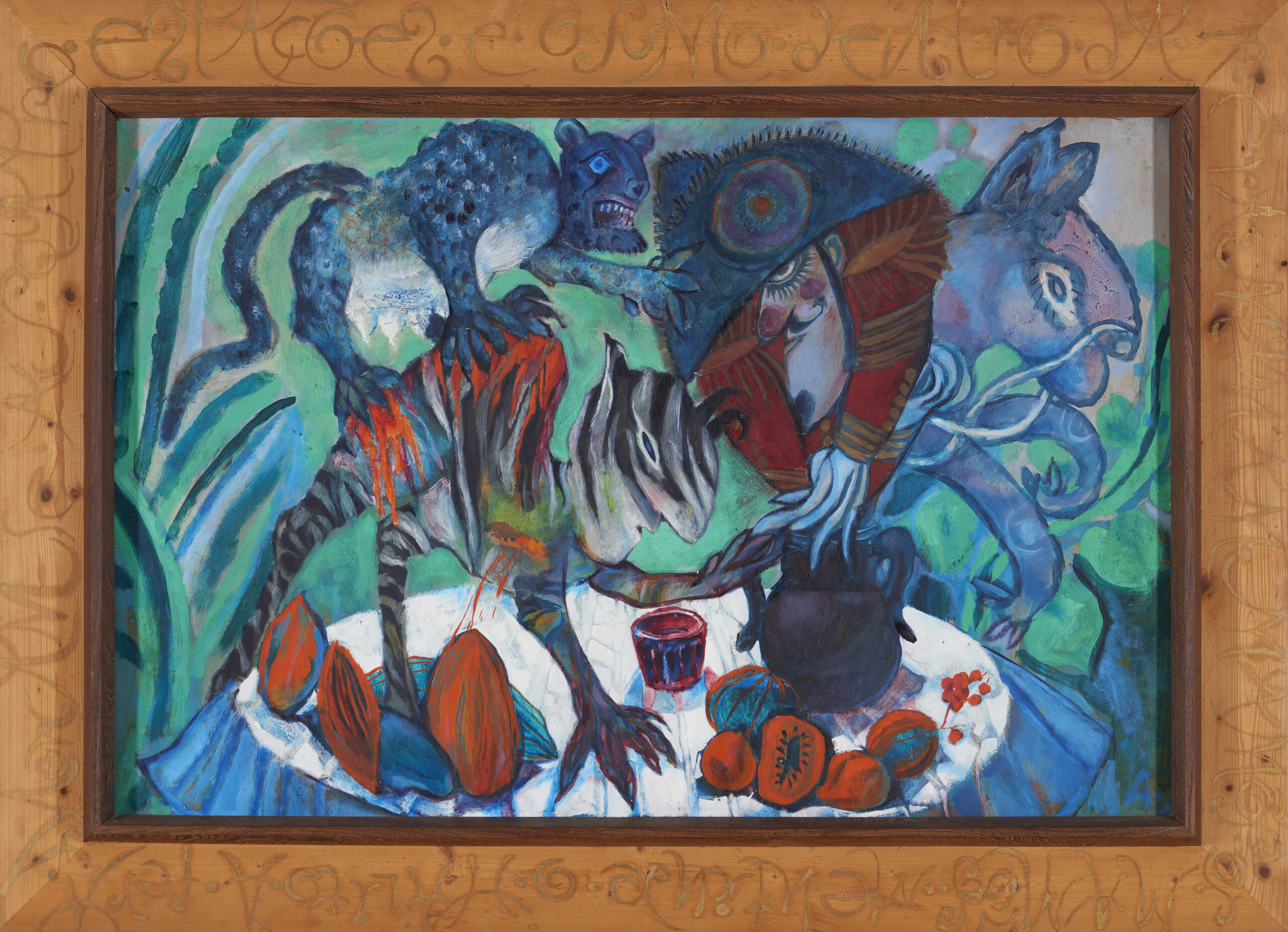
Frame made by the artist.
Catalogue Essay
António Quadros
"Let us ignore the easy irony of those who believe truth is attained in the poverty of a scheme neatly ordered to the eyes of reason. What art is, is to have one's heart in one's head, and a crucifix is neither a coat rack nor a gallows. It is a soul in blood. It is an anti-scheme. Let us reject this art, which is a sterile formalism." (António Quadros, Manifesto da Pintura, 1958)
At the exhibition he held at the ESBAP (Porto School of Fine Arts) in 1958, António Quadros handed out the Manifesto da Pintura to visitors, proposing, in a provocative tone, an alternative to the French school and to the formalism he considered sterile and proud. Rejecting that path as a model for the renewal of painting, he suggested turning instead to what is proper to Portuguese culture: "I looked back and saw a people, who were mine and held the answer: ceramics, 17th and 18th century tiles, engraved utensils, lace, embroidery, folk saints, ex-votos, who knows! It was a sea" (António Quadros, Manifesto da Pintura, 1958).
António Quadros transposed into his work a visual and formal repertoire drawn from Portuguese popular tradition, particularly from its fantastical imagery. His works are inhabited by monsters, hybrid creatures, religious figures, big-headed carnival figures and elements of nature such as animals, leaves and flowers. At times he depicted scenes from his childhood spent between Santiago de Besteiros, Figueira da Foz and Lisbon. He took an interest in the Barcelos clay figurines, which blend the everyday with the fantastical, and worked to promote them, especially the work of the ceramicist Rosa Ramalho (1888-1977). In recovering elements of popular tradition, Quadros's work takes on a magical dimension that goes beyond formal solutions. In turn, in the stylization of these popular motifs, António Quadros comes close to some of the paths followed by modern artists such as Picasso (1881-1973), Amadeo de Souza-Cardoso (1887-1918) or Almada Negreiros (1893-1970), who sought, through the use of less erudite elements, to renew plastic language, exploring more synthetic and pared-down forms. Far from the propagandistic logic of the Estado Novo discourse, which appropriated popular traditions and culture to reinforce the idea of national identity, António Quadros's work articulates what is proper to that popular culture with the intellectual universe, resulting in a more recognizable and therefore more universal language.
His work is predominantly figurative, at times more pared-down, more closely related to the discipline of drawing, at others more expressive, resulting in more dynamic compositions, with the use of contrasting and intense colours in less restrained passages, less confined to figuration. Colour occupies, indeed, an important place in his work. Far from naturalistic use, it functions as an element in the construction of the composition, defining space and creating tension. His career also includes works of a more abstract nature, in which, however, some idea of figuration remains, suggested by elements of the composition or by the work's caption. The word plays, moreover, a predominant role in his artistic production.
One of António Quadros's most striking characteristics is his multifaceted personality and his capacity to pursue different artistic and intellectual activities. Besides being a visual artist, he was a poet, ceramicist, engraver, teacher and pedagogue, among other things. He pursued his activity as a poet with the same commitment as that of visual artist, and cross-contamination between these two practices was frequent. This close relationship is revealed in the appearance of the word as an element of his compositions, exploring simultaneously its semantic value and its formal dimension, through the drawing and composition of the letters themselves. The word often appears on the frames produced by the artist, introducing an additional layer of reading and making the writing itself an integral part of the work, potentially adding complexity to its understanding.
Placed by some authors within Portuguese Surrealism, António Quadros's work reconciles reality and dream in a universe in which they become difficult to separate, recalling in this sense Chagall (1887-1985). But rather than confining it to a category, it is important to understand it as part of a larger body of work, comprising the various activities and experiences to which he devoted himself as a way of understanding and intervening in the world.
Maria Moser
Bibliografia/ Literature:
ALMEIDA, Bernardo Pinto de, “António Quadros”, in AA.VV., António Quadros. O Sinaleiro das Pombas, Porto, Árvore – Cooperativa de Actividades Artísticas, C.R.L., 2001, pp. 73-195.
GOMES, Rita Baptista Maia, António Quadros (1933-1994). Para uma cartografia do seu “mundo.próprio”, tese de doutoramento em História da Arte, especialidade em Museologia e Património Artístico, Faculdade de Ciências Sociais e Humanas, Universidade Nova de Lisboa, 2022.
LAMBERT, Maria de Fátima, “António Quadros – Utopia, Manifesto & Artes”, Latitudes. Cahiers lusophones, nº 25, décembre, 2005, pp. 76-83.
Closed Auction
