
261
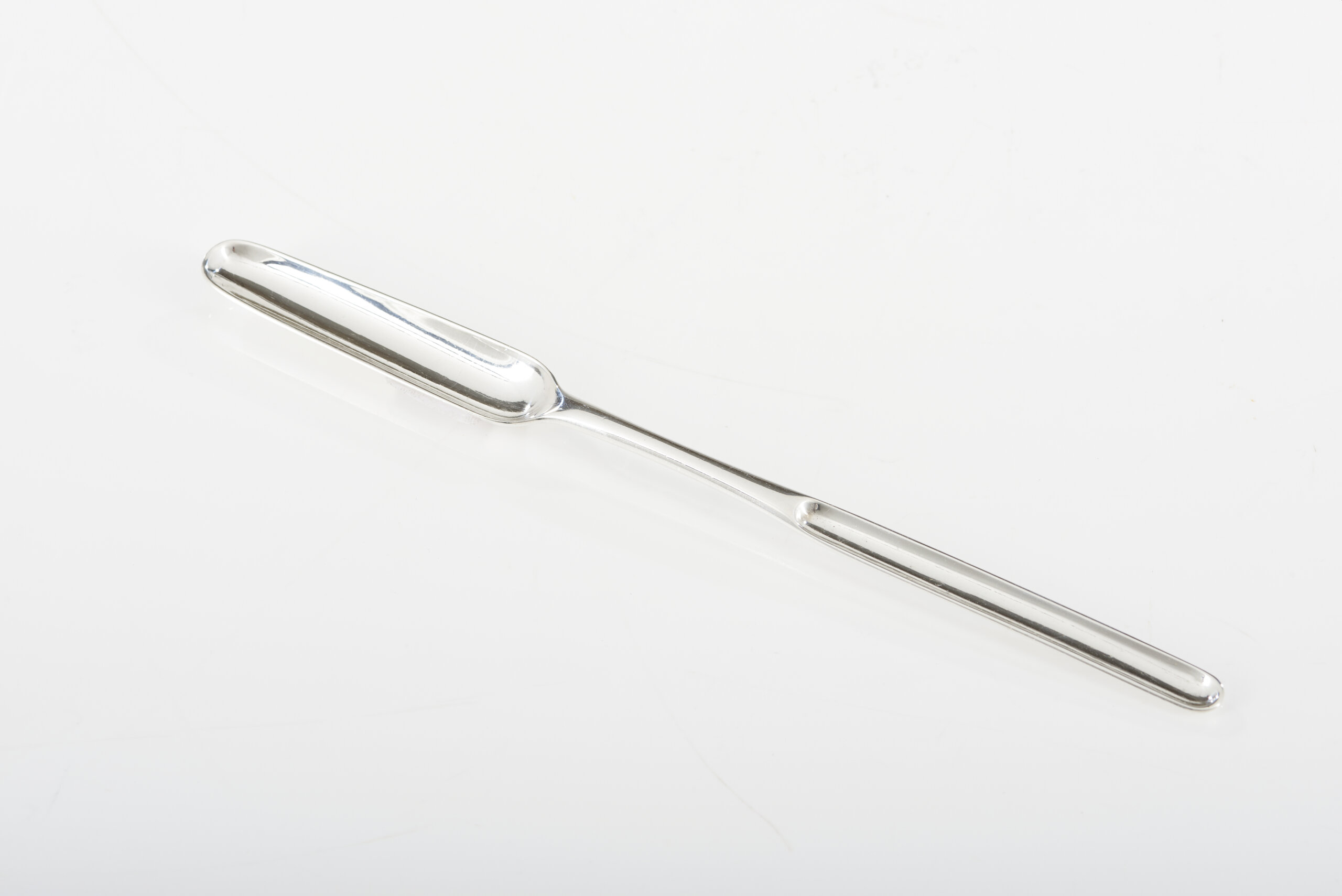
A George II silver marrow scoop
Estimate
250 - 400
Session 1
25 March 2026
Hammer Price
Register to access this information.Description
Silver, fineness .925
Polished decoration
London hallmark (1747)
Length: 22 cm
44 g
Additional Information
The marrow scoop constitutes one of the most curious and refined examples of table utensils conceived for a specific use. Created with the purpose of extracting marrow from the interior of beef bones, this piece responds to a gastronomic taste particularly appreciated at European aristocratic tables of the 17th and 18th centuries, where the unctuous texture and intense flavour of marrow were considered true delicacies.
The growing refinement of table habits, observed in the transition to the late 17th century, prompted the invention of specialised utensils that would allow marrow to be savoured with elegance and decorum. The first known model was the marrow spoon, which appeared around the 1680s, equipped with a spoon-shaped end and a channel-moulded handle, designed to remove marrow from inside the bones. From this inaugural format developed, in the early 18th century, the marrow scoop, whose formal conception was progressively perfected. Rare contemporary examples of the marrow fork still survive, testimony to the experiments and typological variations of that period.
Marrow scoops could present two distinct variants: the single-ended version, composed of a narrow and easily handled channel, and the double-ended version — such as the present example — in which the channels, of unequal widths, were intended for extracting marrow from bones of different sizes. The earliest pieces tend to reveal shorter and broader proportions, whilst those from the mid and late 18th century are distinguished by the elegance and elongation of their forms. In the 19th century, these spoons frequently came to be integrated into silver flatware services, stylistically harmonised with the table set.
As a point of interest, I would like to highlight that in the Victorian era, the appreciation for this delicacy became so widespread that confraternities dedicated to its consumption emerged, such as the Marrow Bone Club of Edinburgh, whose members possessed heavy silver spoons, often ornamented with motifs alluding to marrow — testimony to a gastronomic tradition that united taste with the formal sophistication of the utensil.
Provenance:
Exhibitions:
Literature:
Closed Auction
